
Home » Posts tagged 'STEM' (Page 4)
Tag Archives: STEM

Software Pipeline Connecting Close-Range Photogrammetry and 3D Printing
By Gillian Yue, VI Form
Software Pipeline Connecting Close-Range Photogrammetry and 3D Printing
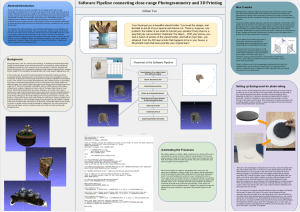
Click on Image to View Full Poster
Abstract/Introduction
The aim of this project is to make it possible for an average person with no prior knowledge in photogrammetry to 3D-print small objects found in daily lives. My work is to create a software that serves as a pipeline; the software connects the multiple processes that are required to transform the input of of photos of the target object into an output of a 3D printable model file. In other words, what used to be a complicated process of switching between different tools and manually processing the model to make it 3D printable becomes a simple one-click routine where the user can provide the initial group of photos, and then simply sit next to the 3D printer to wait for the object to come out half an hour later. (more…)

“Two Worlds”–Drawing with Color Pencil and Gouache
By Leean Li, V Form
“Two Worlds”–Drawing with Color Pencil and Gouache
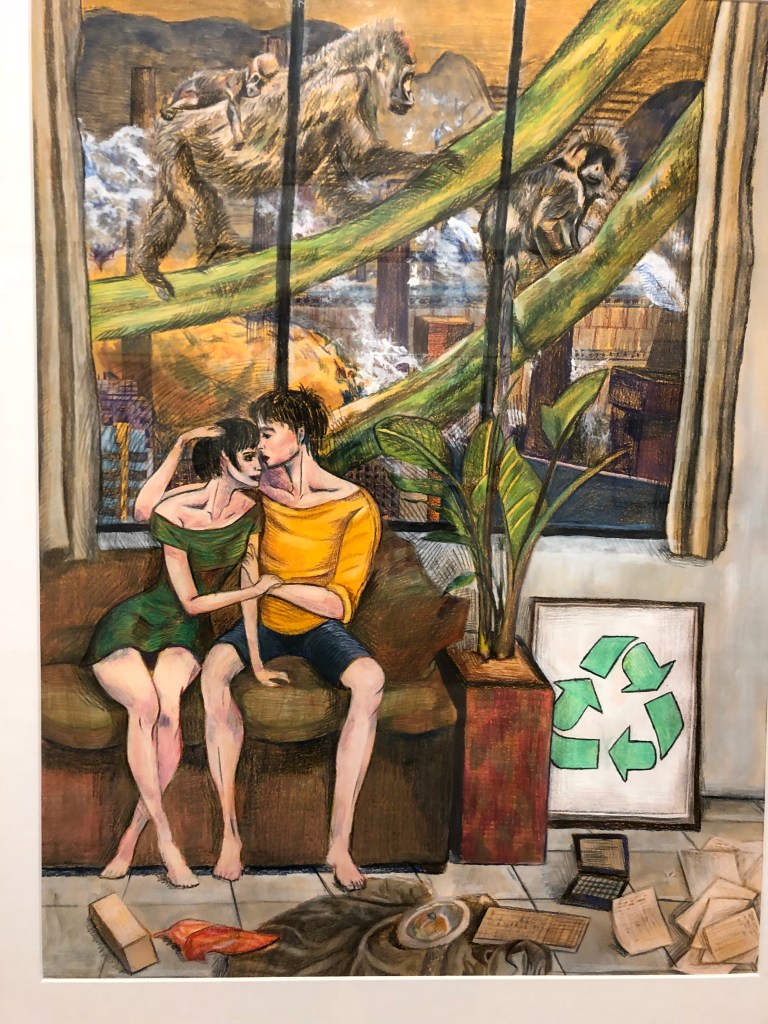 Made with color pencil and gouache (a type of paint) on bright orange paper, this drawing is called Two Worlds. It examines pollution, part of my concentration topic for my Studio III portfolio. I approached the subject from a third person perspective. Inside the apartment, a couple sits comfortably, while outside is a polluted world which animals have to escape. The depiction reveals a discrepancy between human and animals’ experience with pollution. We never realize the price the ecosystem paid for us to enjoy our daily conveniences, such as having electricity and running water. Additionally, since our general public regard pollution as distant and irrelevant, we often made little effort to change. Nevertheless, to accept a polluted world is our selfish decision, negligent of not only the future of humanity but also of the entire ecosystem. (more…)

Autism-Vaccine Controversy: Video
By Izzy Kim & Riya Shankar, VI Form and Haley Dion & Laura Drepanos, V Form
Autism-Vaccine Controversy: Video
Editors’ Note: In Advanced Biology, students were encouraged to tell the story that they felt compelled to relate about their Public Health issue (click here for assignment). In this video, the students integrated a given Case Study with relevant information gathered through independent research. Their integration of the Case Study with additional research reflects an advanced understanding of, and ability to convey, scientific content.
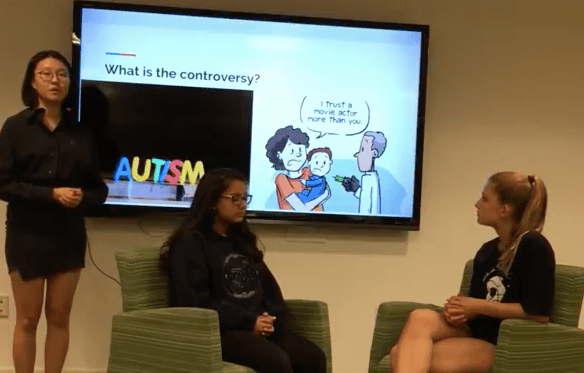
Click on Image for Video

Diminishing the Diversity of Devastating Diarrhea
By Geetika Surapaneni, Frances Hornbostel, & Graham Butterfield, III Form with Will Figueroa, V Form
Diminishing the Diversity of Devastating Diarrhea
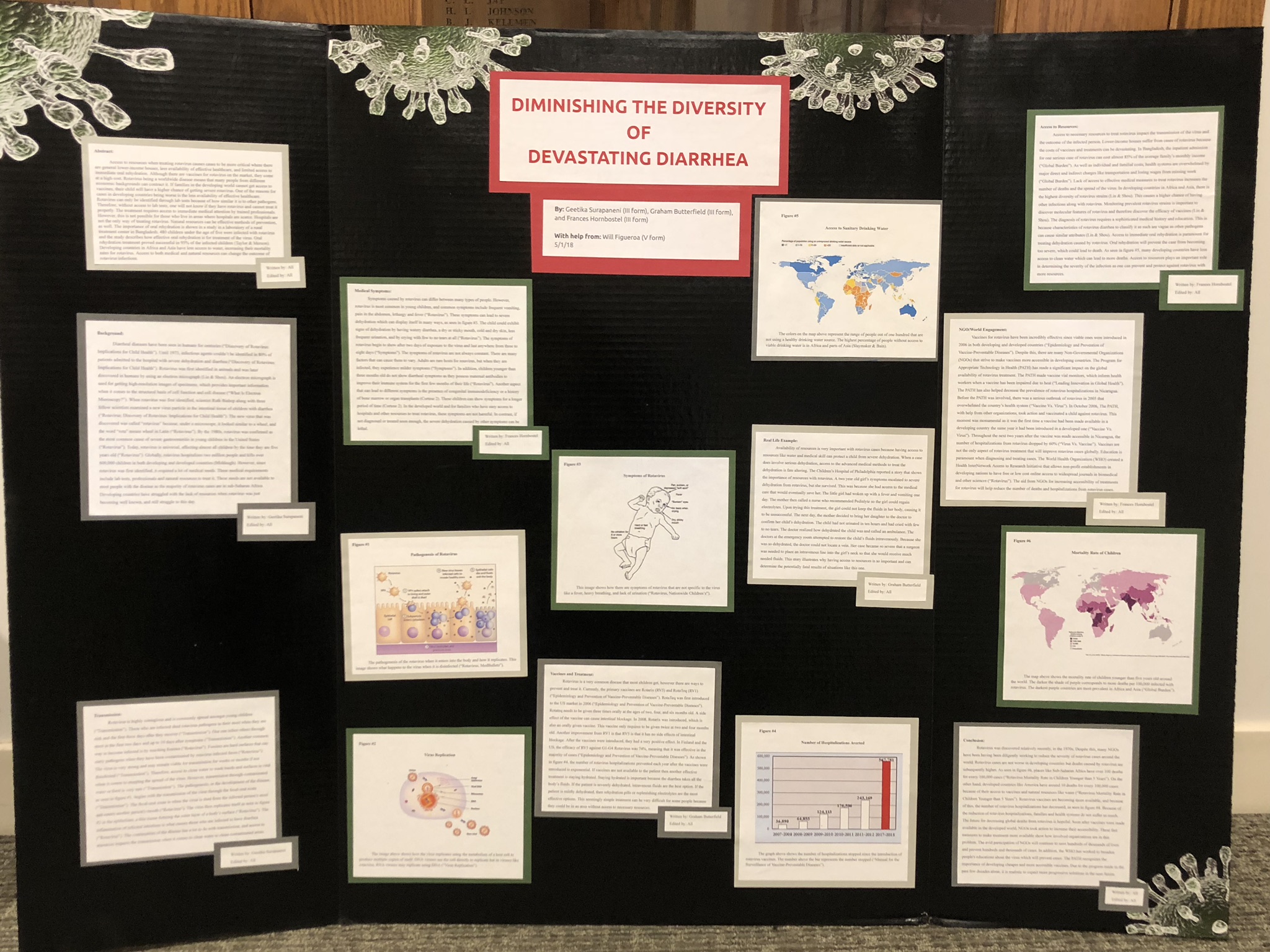
Please click the image to download/see the poster. Scroll below to see each individual piece.
CLICK ON EACH IMAGE BELOW TO ZOOM TO EACH PIECE OF PROJECT. (more…)

Autonomous Navigation and Decision-Making Process Using Machine and Deep Learning
By Jeongyong Chris Yang, VI Form
Autonomous Navigation and Decision-Making Process Using Machine Learning and Deep Learning
Abstract
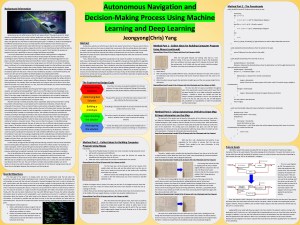
Please click the image to download/see the poster. Zoom in to read specifics.
Autonomous vehicles are self-driving cars that do not require human drivers. They use sensors that are attached to the vehicle as their vision to detect their environment. After the vehicle detects other objects or signals, computer programming (coding) allows them to react to the situations adaptively. Even though the sensors do not need to be improved, the millions of situations the cars can face on roads create difficulties for people to build a sophisticated computer program that makes the autonomous vehicles completely safe on roads.
First, I decided to build an algorithm pseudocode to help resolve this problem. During this process, I built mazes and followed the instructions based on the algorithm manually to check whether the algorithm is effective. I mainly used three different models for my mazes, each with different difficulty levels to ensure that the algorithm works every time. Then, I decided to record the information (velocity and displacement for both x and y directions) about the vehicle on the map so that the following vehicles can get a picture of the map automatically. However, if the subsequent vehicle detects a different or an altered map with its sensors, the new information will also be recorded on the map. Finally, the final vehicle will follow the path set by the first vehicle, but the map will guide the car with the most efficient path after completely learning and optimizing the possible paths.
Melatonin’s Effect on Learning and Memory in a Tauopathy Model of Alzheimer’s Disease in Drosophila melanogaster
By Sophie Haugen and Sada Nichols-Worley, VI Form
Melatonin’s Effect on Learning and Memory in a Tauopathy Model of Alzheimer’s Disease in Drosophila melanogaster
Abstract
Alzheimer’s Disease (AD) is a progressive neurodegenerative disease that causes devastating memory loss and cognitive decline in humans. There is no current cure for AD. Research studies show that oxidative stress is correlated to and possibly a cause of this neurodegeneration. Because antioxidants such as melatonin have been found to reduce oxidative stress, melatonin could alleviate neurodegeneration and serve as an effective dietary supplement for people with with AD. In this experiment, a tauopathy Drosophila melanogaster group
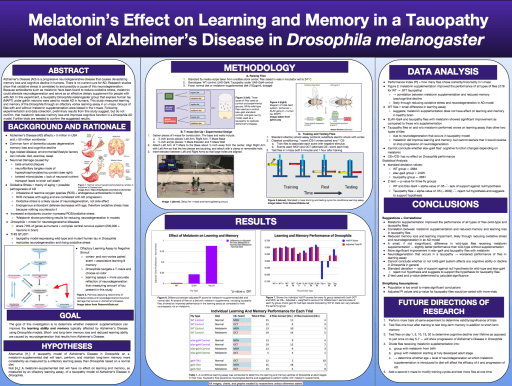
Please click on the image to download/see the poster. Zoom in to read specifics.
that express human tau (MAPT) under gal4in neurons were used to model AD in humans. This study measured learning and memory of the Drosophila through an olfactory vortex learning assay in a t-maze. Groups of flies with and without melatonin supplementation were tested in the t-maze. Following experimentation and data collection, preliminary results from this study suggest, but do not confirm, that melatonin reduces memory loss and improves cognitive function in a Drosophila AD model. Further trials are needed to confirm the suggested results.
Click here for full LAB REPORT. (more…)

Calculus: Optimization Problem for Derivatives
By Haley Dion, V Form
Calculus: Optimization Problem for Derivatives
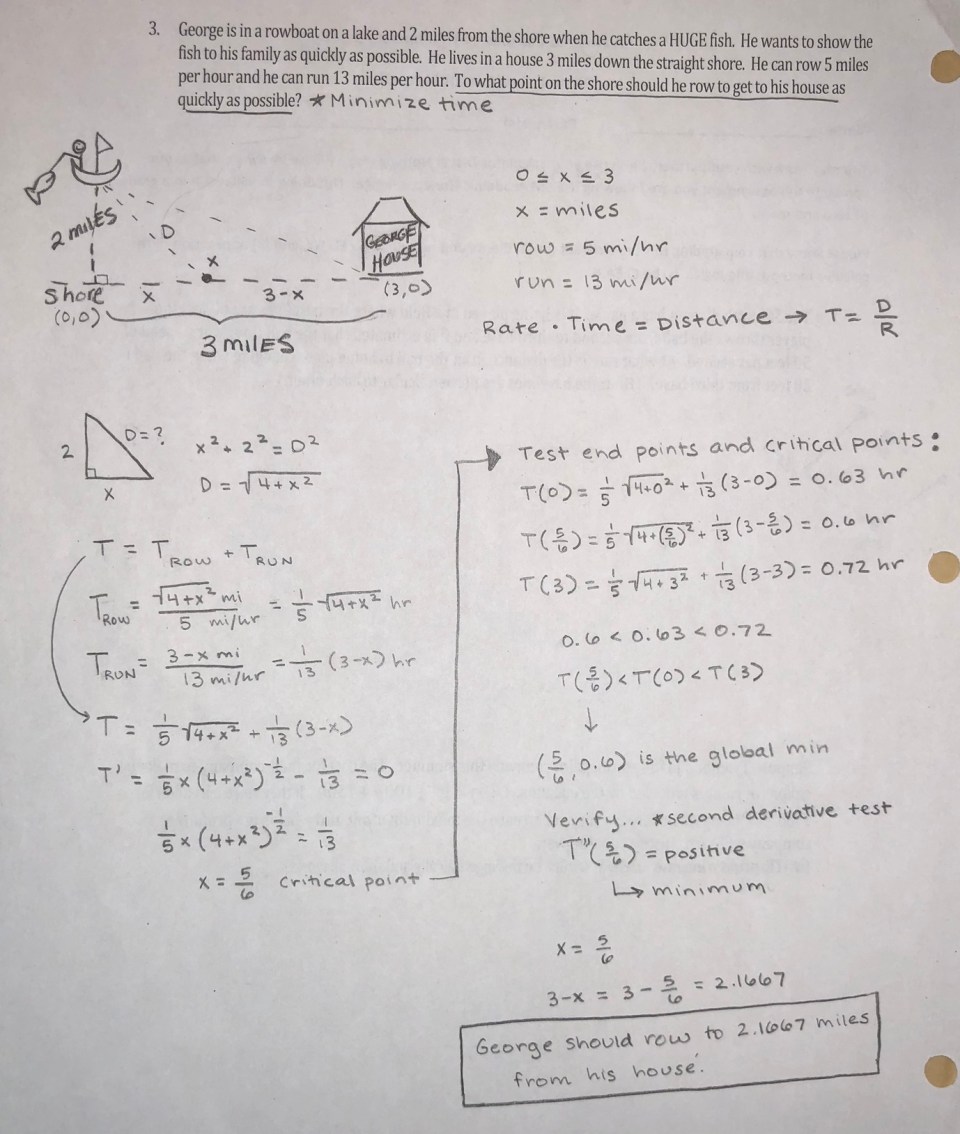
Editor’s Note: In Advanced Calculus, students spend considerable time studying derivatives (rates of change) and their applications. This problem is an “optimization” problem that asks students to calculate the best or optimal value relative to a particular situation. Students need to first interpret the meaning of the problem (which involves particular rates of change) and model the situation with a function.
In this problem, George wants to minimize the time it takes for him to get home. Haley applied her understanding of derivatives to determine the exact spot on the shore where George should leave his rowboat before running home.
Biology: Membrane Structure and Function
By Alex Cardonick, V Form
Biology: Membrane Structure and Function
Editors’ Note: In Advanced Biology, students are often evaluated on the reflection of their learning process. They constantly ask themselves questions that demonstrate advanced scholarship such as “How am I connecting each part of my learning into a flowing story?” and “What do I still not understand?” This form of deep reflection is summarized in each student’s ePortfolio at the end of a unit, which includes several different Learning Outcomes ranging from “Dynamic Homeostasis” to “The Central Dogma of Biology.” These Learning Outcomes are often present throughout multiple units, and therefore challenges the students to synthesize information across different areas of focus.
Linked here is Alex Cardonick’s ePortfolio on Learning Outcome 6: Membrane Structure and Function, including four Artifacts of Learning, including text, video, and images.
Introductory Narrative:
Cell membranes act as the “guards” of the cell. Membranes’ structure consists of phospholipids tightly 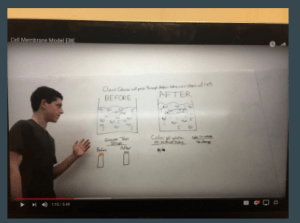 knitted together by their hydrophobic tails, with the hydrophilic heads sticking out on either side. This phospholipid bilayer structure makes membranes semi-permeable; they let small, non-polar molecules such as water and carbon dioxide in, while keeping out large and polar substances such as starch and Iodide anions. In addition, cell membranes can be modified to help cells perform specific functions. Proteins added into the phospholipid structure can create transport channels for molecules that cannot travel through the membrane itself, such as Na+ ions in the nerve impulse. These ions allow a neuron to send a signal in the form of an action potential. Furthermore, molecules and ions can even move against the concentration gradient by active transport when a transport protein and outside energy are provided. This type of movement across a membrane allows essential functions such as the repolarization of the nerve impulse to occur when Sodium-Potassium pumps “reset” the nerve impulse to its resting membrane potential by moving the ions against the concentration gradient. (more…)


 LEO
LEO 