
Home » Posts tagged 'Religion'
Tag Archives: Religion
Faith and Negligence: Christian Perceptions and Interactions with Chinese Immigrants in 19th Century America
By Steven Zhang, VI Form
Faith and Negligence: Christian Perceptions and Interactions with Chinese Immigrants in 19th Century America
Editor’s Note: This paper was completed as a part of the History Research Fellowship, a one-semester course available to sixth form students.
Introduction
On one night in 1887 in San Jose, California, fires clawed at the sky. Smoke billowed from collapsing roofs of Chinatown apartments and stores, and winds sent trees into frenzies. Amidst this chaos, mothers, their clothes coated in ash, hustled their coughing children to safety. The origin of the fire, which uprooted the lives of approximately 1,400 Chinese residents, remained shrouded in mystery. However, clues to this destruction emerged in a solitary photograph that captured the aftermath of the devastation. In it, hundreds of white working men stood watching the destruction of one of San Jose’s Chinatowns (Figure 1).

Figure 1: The Burning of San Jose’s Chinatown
While the facts of this case are still obscure, the San Jose City Council a hundred years later would unanimously vote a resolution to apologize to Chinese immigrants and their descendants for the role the city played in “systemic and institutional racism, xenophobia, and discrimination.” Today such a terrifying act might be widely condemned, but at the time it was merely one of many incidents of anti-Chinese violence that went relatively unnoticed. In fact, the burning of San Jose Chinatown in history is often eclipsed by similar, anti-Chinese acts, such as the more devastating Santa Ana Chinatown fire. These incidents, lost in a history of anti-Chinese violence, marked the peak of hostility in the late 1800s.
(more…)Suffering in Chinese Buddhism and Italian Christianity: Comparison Between Northwestern Chinese Mogao Grottoes and Italian Christian Artworks
By Sherry Mi, IV Form
Suffering in Chinese Buddhism and Italian Christianity: Comparison Between Northwestern Chinese Mogao Grottoes and Italian Christian Artworks
Student-Submitted Note: I conducted this individual research in the Summer. Inspired by my pre-COVID travels to the Mediterranean region, I became greatly interested in European art history while constantly being influenced by Chinese art and culture. My research is a response to my childhood wonder about religious art.
INTRODUCTION
Visual art is one of the easiest ways to communicate, while the spread of a religion depends on the diffusion of its beliefs, which solely depends on communication. For this reason, artists have created countless religious works in the past millennia. Furthermore, the use of religious symbols increased as religions, usually including scriptures, holy figures, and taboos, were systematized. Symbols convey essential religious ideas to the viewers, including suffering.
In my 2020 visit to the Mogao Grottoes in Northwestern China, I also noticed that Buddhist stories of sacrifice and suffering were also one of the most depicted images. Religious beliefs, I conjectured, supplement images of suffering, delivering an important lesson about pain to the followers: Why is pain present? How can one cope with it? Notably, religious art only represents the opinions of its artist, probably on behalf of society, but not God. Opinions may change over time.
I soon discovered that these images were produced inconsistently as the religion evolved. I recorded my discoveries in Buddhist and Christian art in the following analysis. As the religion developed, religious art deviated from images of suffering. The reduction of such images hinted at a transformation of the invisible relationship between religion and society.
What force could drive this palpable change? I noticed similar trends in the development of Chinese Buddhist and Italian Christian art: images of suffering were abundant for one historical period, but declined as the next period began. I also wondered if Buddhist and Christian artists interpreted suffering similarly by making similar artistic choices. This analysis is a possible answer.
(more…)Snowballing Towards Anti-Ethnic Homogeneity
By Steven Zhang, VI Form
Snowballing Towards Anti-Ethnic Homogeneity
Editor’s Note: This project was made possible with the support of the Class of 1968 V Form Fellowship. At their 25th reunion, the Class of 1968 created a fund to provide grants to V Form students for independent study during the school year or, more commonly, during the summer between V and VI Forms. Their intent in establishing this fund was to reward independent thinking, ingenuity, and planning and to encourage the student in exploring non-traditional fields of inquiry or using non-traditional methods of investigation.
Student-Submitted Note: Over my Junior year, I embarked on an ambitious research project rooted in personal experience. Eight years ago, I left my town’s Asian church, noticing over time that older friends were departing too. What prompted so many people with similar backgrounds to collectively leave? I dove into academic research. I exhausted every accessible paper, emailing professors for copies when articles weren’t free. I spent months interviewing and writing, dedicating 2-3 weekday hours and 4-8 weekend hours. It was incredibly hard to conduct research all by myself. I submitted an abstract summarizing my findings to UC Berkeley’s conference on Asian Pacific American religions, and was accepted based on my paper and my paper’s abstract.
Abstract
Despite recent attention on second-generation Asian American Christians, many racialization and ethnicization theorists often neglect the migration of second-generations from mono-ethnic churches to multi-ethnic churches. Through an analysis of the oral histories of nine East Coast, American-born, East Asian college students, my paper argues how race and cultural factors in ethnic, predominantly white, and multi-ethnic churches influence second generation students’ desire for diverse congregations. This study contends that due to family pressure on youth and overbearing cultural values in an ethnic church, second generations avoid Asian-homogenous religious environments and their parents’ ethnically bounded faith. Leaving instead for predominantly white churches, they find that cultural awareness on issues of marginalization is lacking. In both churches, second generations grow averse to homogeneous environments as minorities with unique cultural differences. In college, they resolve the desire for heterogeneous religious environments through the diverse college campus that offers religious autonomy and a religious buffet of ministries. Among the various options, the multi-ethnic ministry especially appeals to second generations by creating a minority-focused space infused with different perspectives. My paper uncovers a pattern of religious attendance among second-generation Asian Americans, analyzing how, when, and why religious diversity in congregations is vital.
Paper presentation
Introduction
My paper focuses on second-generation Asian Americans who attend multi-ethnic churches and explores their motivations for desiring and attending diverse congregations.
I employ a snowball metaphor to demonstrate how different factors combine to create a desire for diversity. The “compounding factors” to the snowball of anti-homogeneity are family pressure that creates desires for separation and independence, overbearing cultural values that create a dislike for homogeneous environments, reduced marginalization that creates a desire for a diversity of members, and a desire for diverse theology. This snowball of anti-homogeneity stops rolling after entering college, where the accumulation is resolved through the diverse college campus that offers religious autonomy, a religious buffet of ministries, and more diverse perspectives.
My methodology was emailing and networking. I emailed nine East Coast, East Asian, college students on college campuses and college graduates from nearby multi-ethnic churches to ask them these questions.
Before I go into my findings, I would like to provide a literature review.
As many researchers have noted, second generations embark on the silent exodus, a mass migration away from their mother churches. They leave because of cultural differences between generations and intergenerational leadership difficulties. The question of where they go has been answered by numerous authors who argue that second generations stay in ethnic and racial enclaves. They either head to Asian American ministries, return to their ethnic churches, or pave a new pan-Asian path, which although different from their parents, often carries mono-ethnic notions.
(more…)Becoming Dr. King’s “Beloved Community”
By Rev. Katie Solter, Religion Faculty and Associate Chaplain
Becoming Dr. King’s “Beloved Community”
Religious scholar Karen Armstrong writes: “Religions have functioned throughout human history to inspire and justify actions that range from heinous crimes against humanity to nearly unfathomable acts of compassion, courage, and generosity.” In my role as a religion teacher and chaplain at St. Mark’s, dedicated to the work of building an anti-racist school, I strive to provide a balanced representation of religions. We must understand religion’s complicity in the “heinous crimes” committed often in the name of religion’s presumed superiority of the dominant group throughout history, while exploring the important role religion plays in fighting oppression and promoting the values of non-violence, social justice, and equality as part of the “unfathomable acts of compassion, courage and generosity” religion inspires.
The Role of Religion on January 6, 2021
The events of January 6, 2021 serve as a poignant example of these contrasting ideas. That morning we woke up to the news of Jon Ossoff’s and Raphael Warnock’s historic victories in Georgia’s run-off Senate elections, with Ossoff becoming the first Jewish Senator and Warnock, the first African-American Senator elected in the state of Georgia. In St. Mark’s required religion class, Judaism, Christianity, and Islam (JCI), we discussed the rise in anti-Semitism this year and Jon Ossoff’s run for senate told a familiar story of how Ossoff’s opponents deployed anti-Semitic tropes and stereotypes to undermine his candidacy. An infamous campaign advertisement, uncovered by the Jewish newspaper The Forward, exaggerated his features to make him look more stereotypically Jewish. Yet, on this occasion, these age-old tactics failed as Ossoff achieved his improbable victory in a traditionally conservative state.
At the same time, Rev. Rapheal Warnock’s election highlights the role the Black church continues to play in the political arena given the record turnout in Georgia for Black voters. As Rev. Dr. Cynthia Hale writes: “Since the end of the Civil War, the Black church has been a critical institution within the pro-democracy movement. Collectively serving as a general for justice, the Black church continues to be a refuge for the oppressed and a force with which to be reckoned on the issue of racial and economic equality through the power of the ballot.” Senator Warnock is senior pastor at Ebenezer Baptist church in Atlanta, where Dr. Martin Luther King, Jr. once served and his election represents a victory for the work Dr. King and the Black church have played in promoting the spiritual and social justice principles of Christian belief.
The election of these two candidates alone–as examples of the important role religious understanding plays in the current political landscape– provided pertinent discussion topics in a JCI class at St. Mark’s. As we all know, later that afternoon, this day of historic victory for Jews and Black Christians in Georgia, quickly turned to a day of infamy. The attacks on the Capitol building highlighted the role religion can play in perpetuating hatred and White supremacist ideology, with Christian flags and banners waving side by side with anti-semitic and racist ones. In just a few short hours, we have two milestone events in our political history that illustrate the sometimes divergent, even contradictory roles religion can play. My job as a teacher of religion in an historical and educational moment that calls upon us to create an anti-racist school is to finds ways to place these moments in a broader intellectual context so my students can have a more balanced and nuanced understanding of religion’s complex legacy.
(more…)
Faith and Doubt: Emotion’s Place in Epistemology
By Daniela Ortiz, V Form
Faith and Doubt: Emotion’s Place in Epistemology
In this paper, I will argue that faith is comprised of knowing God without certainty. I will argue that this kind of faith does more good in the world than absolute certainty in God. People of faith must face doubt to strengthen belief. Although this seems paradoxical, the outcome of continuously facing doubt is a stronger commitment to looking beyond one’s self and following through on a commitment to treat all other people with respect.
Can we know God? Let us first define knowing.
Knowing is split into two categories- the logical knowing and emotional knowing. Logical knowing is what is certain and can be derived from the senses. In this, I agree with Hume. Knowledge of this kind is about the physical world around us and is known through data of the empirical kind such as our sensory information. There are limitations to what our senses can have us knowing. If a person’s senses deceived them, for example, by seeing a fake oasis in a desert, then this knowing may be faulty. But a singular type of incident should not be taken to alter the whole principle that logical knowing is defined by what we can perceive and what we can think. Also, logical knowing is similar to the way mathematics is used to model occurrences in the world. The use of logic conduces one answer. When there is only one answer, we shall call this certainty. When there are multiple answers, uncertainty begins. The category of emotional knowing often resides with uncertainty because our emotions are hard to maintain a grasp on long enough for one answer and train of thought to be maintained from the impression of the emotion. In section 2, paragraph 12, Hume makes a clear distinction between our thoughts and our impressions. Ideas are limited only to what we can expand upon from our sensory information, or from our desires and feelings. The argument here is sound. In paragraph 14, Hume explains that every thought we have is copied from a similar, earlier impression. Emotions may be short-lived, but they are more vivid, and all of our ideas about the world are formed from them (Hume 2). To bring it to a point: although emotions are fleeting, the emotional knowing should not be discounted as our impressions are stronger and more vivid than the ideas they will eventually inform.
(more…)
Survival With God: On Piers Paul Read’s Alive
By Lindsay Davis, IV Form
Survival With God: On Piers Paul Read’s Alive
Alive by Piers Paul Read, a survival story of a plane crash in the Andes Mountains, recounts how the survivors’ trust in God influenced their resilience during a crisis of life and death. In 1972, a plane carrying Uruguayan rugby players and other Uruguayan citizens crashed in the middle of the Andes. While the travelers suffered many injuries or died from the crash, the fight on the mountain came most from their will to survive and the actions needed to outlast the miserable conditions of the Andes. The rations of food, sleeping conditions, injuries, and pre-existing relationships affected the mental status of each survivor. Their bond with God helped them to make life at the Fairchild fair and optimistic. The survivors who boarded the Fairchild came close to death in the Andes, but their hope for survival and reliance on God pushed them through the mental pain and helped inspire their faith in physical recovery.
The survivors ate the flesh of their dead companions knowing that was their only way to survive. God had inspired the courage to engage in repugnant cannibalism. Over the course of the seventy-two days, while the survivors’ mentality fluctuated, food supplies ran out and the concern of starvation became apparent. The injuries and losses suffered by some of the Fairchild passengers would not matter if they could not feed themselves. Although most of the boys were expecting the point at which they would need the protein of their fellow dead friends and passengers, Canessa was the first to discuss aloud with the group. After eliminating the idea of eating the seat cushions and digging deep for grass, the bodies that surrounded them on and in the snow were the last plan. (more…)

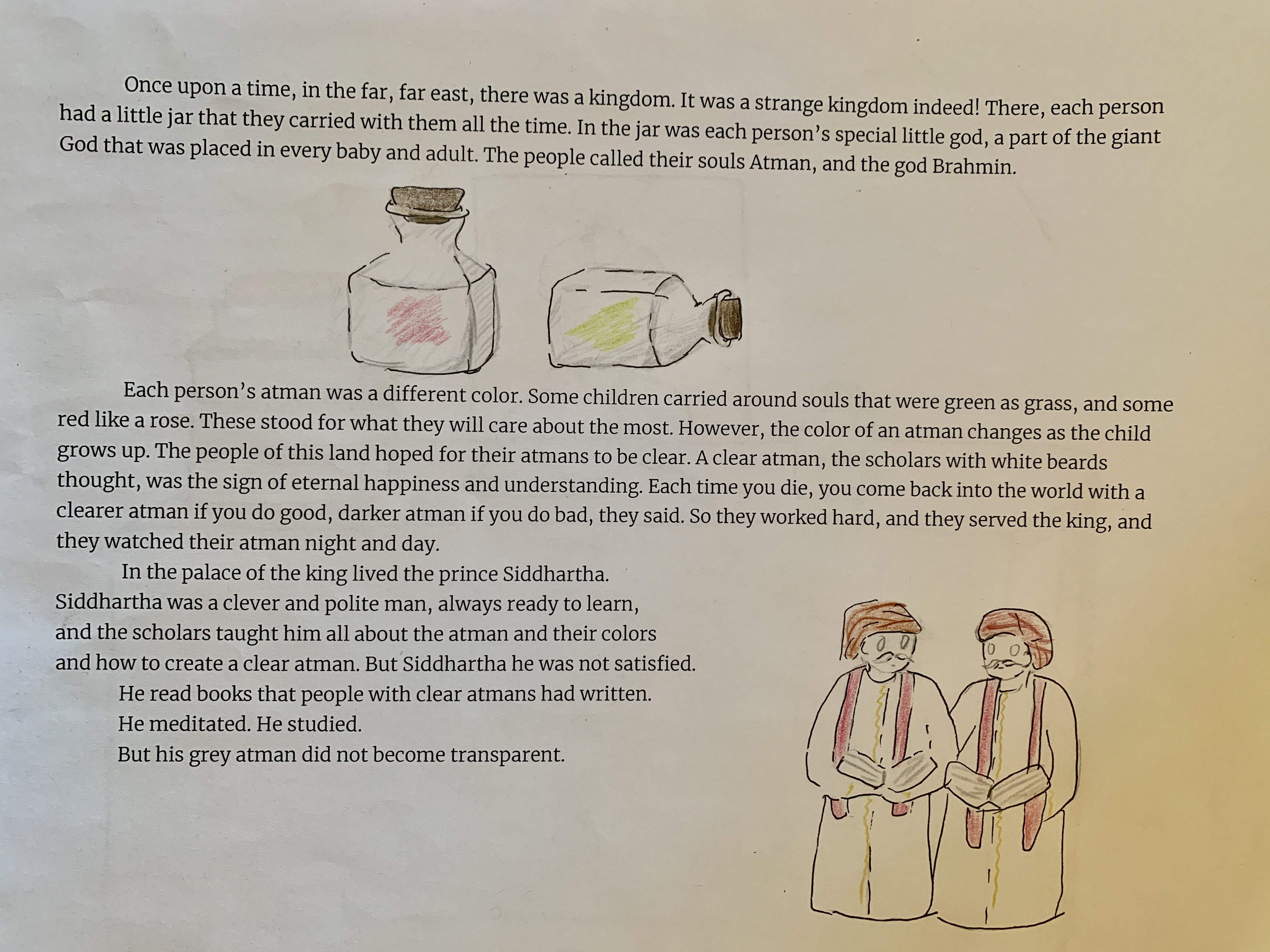
Siddhartha: Children’s Story
By Lina Zhang, IV Form
Siddhartha: Children’s Story
Editor’s Note: In Reverend Solter’s religion elective “The Quest,” this was the prompt for the assignment: Write a children’s story about Siddhartha’s quest for spiritual enlightenment. Your story must include 1. 10 quotations from Herman Hesse’s Siddhartha–distilled to a level appropriate for children (the quotations should follow Siddhartha’s journey along the Noble Eightfold Path); 2. Illustrations–you can use images from the web or your own illustrations; 3. A teaching on understanding the basics of Hinduism and/or Buddhism.

The Epistemological Theories of Descartes, Hume, and Kant As Well as The Implications for the Existence of God
By Lora Xie, V Form
The Epistemological Theories of Descartes, Hume, and Kant As Well as The Implications for the Existence of God
Editor’s Note: This is the assignment from the Advanced Religion course–“In whatever way is most helpful to you (prose, outline, diagram, drawing), tell the story of Descartes’ Rationalism, Hume’s Skepticism, and the Kantian synthesis. You will share this in class and also hand it in. You will be graded both on the effectiveness of your method and on your evident understanding.

Click on this Image to Enter Slideshow!
Link to Slideshow:
https://docs.google.com/presentation/d/1-usiBKsrTmdWRX_Zzk1GDdzXFtaOc_NWRJnUj4Nqwd4/edit?ts=5bc653e0#slide=id.g43a807e277_0_746 (more…)


 LEO
LEO 