
Home » Posts tagged 'Prize Day' (Page 3)
Tag Archives: Prize Day

“Waves”: A Short Story
By Yevheniia Dubrova, VI Form
“Waves”: A Short Story
Editor’s Note: The following short story was submitted as a final project in “The Rise of the Short Story: Creative Short Fiction Writing.”
Before Pat was born, my mother and I used to talk. She let me sleep in her bed when dad worked night shifts, and although I never really understood what his job was, I knew it was some kind of important thing because he worked a lot, and that says something. It didn’t bother me much back then, and sometimes, I even wished he would stay at work more often so that I could sleep at my mom’s. She left orange peels on her nightstand until they dried out and wrinkled up. My dad would say they look like pork rinds and throw them away, but it smelled like Christmas, and I liked it. Her bed was solid and soft at the same time, and I swear I could drown in her heavy blankets and crisp linens. We rarely cuddled — mom doesn’t like cuddling — but she talked to me about all sorts of things, and her voice would always put me to sleep, even though I tried to stay awake for as long as possible to listen to her some more.
She didn’t talk much about her youth, except for that one time she told me about finding her mother’s book on childbirth. She saw the pictures. The pictures must have made a lasting impression on my mom because she swore to never have a baby. I asked her if the real thing was as bad as the pictures. She said if she had known it would be that bad, she would never have had me in the first place. She then brushed my hair with her fingers and said she was glad she had me after all, but that birth thing was really bad.
“Can you imagine? All that pain and blood? And with a head like yours… Oh, sweet Jesus Christ, I thought you were going to rip my hips apart!”
(more…)
Classical Diploma Mosaics
By Illia Rebechar and Emily Taylor, VI Form
Classical Diploma Mosaics
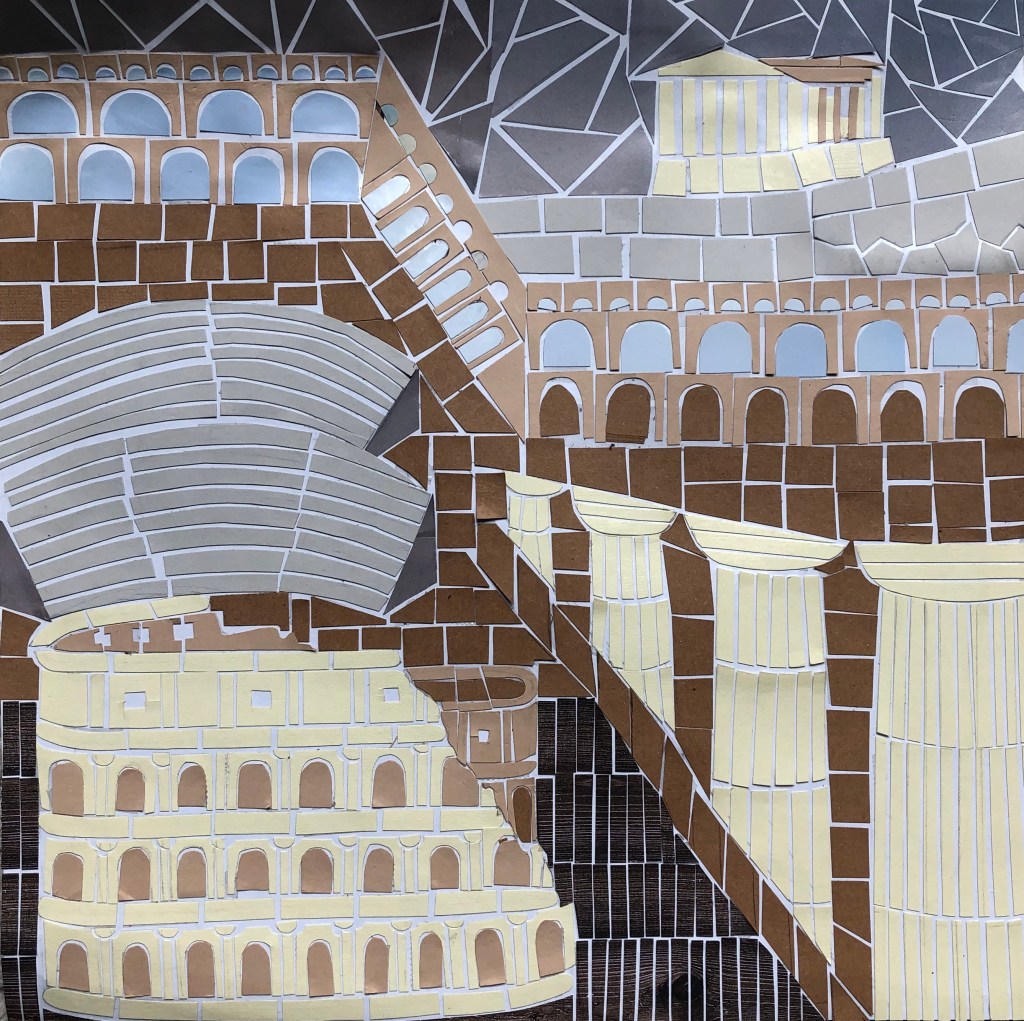
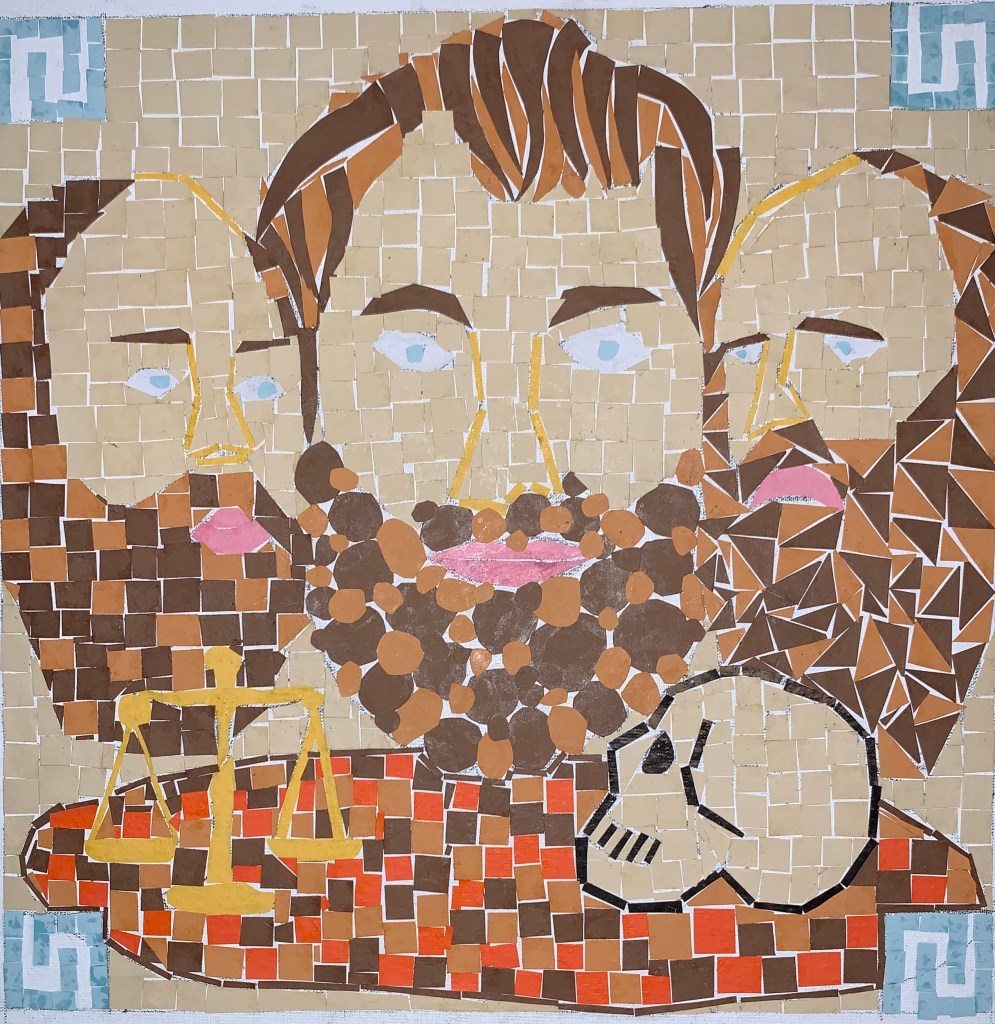
Note: Each year students who are taking Greek II and have also taken three years of Latin work together throughout the spring to present a project at the end of the year to receive their Classical Diplomas. This year the project was driven by the question: How is the study of Classical languages and cultures still relevant to the 21st-century learner? Students worked through rounds of brainstorming over Zoom and ultimately ended with a project that would use a classical art form, mosaic pieces, to communicate the relevance of classical influences all around us.

The Impact of Black Sesame Pigment on Drosophila Melanogaster with Alzheimer’s Disease
By Ally Bauer, VI Form
The Impact of Black Sesame Pigment on Drosophila Melanogaster with Alzheimer’s Disease
My project for the STEM Fellowship was studying the impact of black sesame pigment on drosophila melanogaster with Alzheimer’s disease. Alzheimer’s Disease is a neurodegenerative disease that affects over 44 million people worldwide. One of the hallmarks of Alzheimer’s Disease are amyloid-beta plaques that form in between the neurons and disrupt cell communication and function. Black sesame pigment, derived from black sesame seeds, has been proven to reduce the aggregation of these plaques in vitro studies. Drosophila melanogaster, or fruit flies, are wonderful model organisms that are utilized for their quick reproduction rate, easily manipulated genome, and the relation its genome has with humans. For my experiment, I was able to track the progression of memory loss in flies with Alzheimer’s disease. I had multiple groups to show me if greater concentrations of black sesame pigment would slow the progression of memory loss in the flies. Although the results of the experiment proved my null hypothesis to be correct, I now have a greater understanding of Alzheimer’s Disease, the scientific method, and having control over what I learn and how I learn it. I am incredibly grateful for Ms. Lohwater, Mr. Loomer, Mr. Valitutto, and the five other STEM Fellows who have mentored me, shaped my project, and problem solve throughout the year.

DIYBaseball: Extension Through Contact
By Brett Federico, VI Form
DIYBaseball: Extension Through Contact
During the Spring Semester, I worked alongside Mr. Bauer in Engineering to develop inexpensive alternatives to popular baseball training aids on the market today. Upon completion, I produced an eight minute video that explains my product’s effectiveness and incorporates coaching cues for those using it. This product in particular teaches players how to properly extend their hands after contact, creating more consistent results. Depending on the location of the pitch, the audible “click” of the baseball should come between the shortstop and the second baseman. Mr. Bauer pushed me to develop a universal training aid for this project, as my previous products were developed to suit an athlete my size. My original design incorporated a fence, a rope, a 25lb weight, two rock-climbing clips, and 6 Wiffle balls, so as you can imagine, there was a lot of trial and error to get to the product that you see in the video!

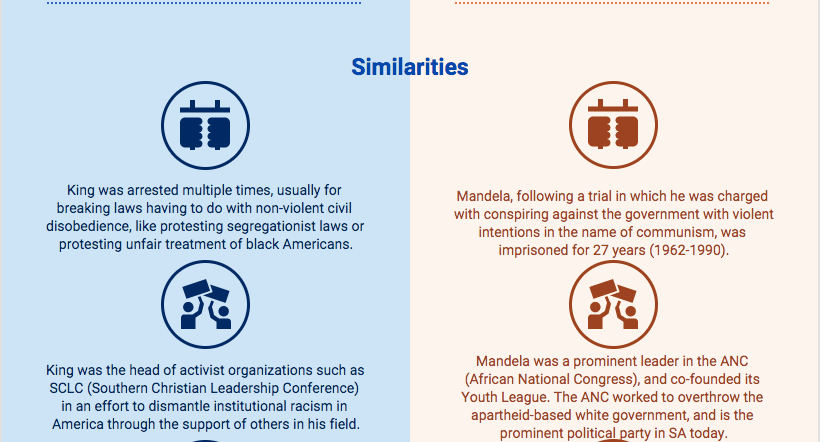
MLK and Nelson Mandela: A Comparative Infographic
By Truman Chamberlin, VI Form
MLK and Nelson Mandela: A Comparative Infographic
Note: This final product was completed for the Lions Roam course, “Race, Racism, and Reconciliation Since 1945: Lions Roam in the American South and South Africa.”



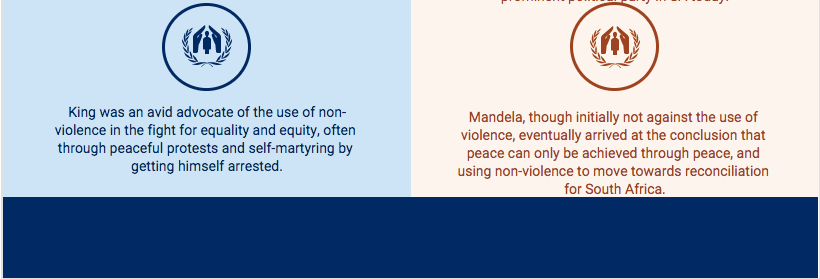

Truman Chamberlin is a VI form boarding student from Chapel Hill, North Carolina. His favorite subjects and pastimes are English and baseball, and he enjoys music, travel, and civil discourse.

How serious is air pollution in worsening the effects and spread of COVID-19?
By Ashley Battiata, VI Form
How serious is air pollution in worsening the effects and spread of COVID-19?
Student Note: For the final two weeks of Remote Learning in Advanced Environmental Science, I chose to learn more about COVID-19. The prompt was broad; therefore, I specifically focused on how air pollution and COVID-19 are related. For example, does air pollution spread COVID-19 faster, and does it worsen the effects of the pandemic? Or do these two environmental problems not impact each other at all? While researching, I expanded into another topic that most people weren’t talking about: how both air pollution and COVID-19 are affecting a specific demographic.
A very specific type of air pollution called fine particulate matter or (PM2.5) is associated with an increased risk of COVID-19 in the United States. PM2.5 is associated with burning things, such as coal in a power plant or gasoline in one’s car. It is dangerous because of how microscopic the matter is, specifically 2.5 micrometers in diameter, which gets into the lungs and bloodstream and causes damage to our health.The smaller the matter is in diameter, the easier it is to penetrate into the lungs and bloodstream and to get past airways designed to cough out irritants. This leads to future problems such as asthma, heart attacks, and other chronic diseases. According to a Harvard study, an increase of only “1 μg/m3 in PM2.5 is associated with a 15% increase in the COVID-19 mortality rate,” which proves that there is a relationship between exposure to air pollution and COVID-19 mortality rates.
(more…)
Space is Physical. Place is Personal.
By Kian Sahani, VI Form
Space is Physical. Place is Personal.
As Thomas Bender says in Making Places Sacred, “the places we make act as mirrors to our lives. They reflect the good or ill, passion or indifference, with which we hold them back on to the people whose lives they touch. Places, as well as people, draw sustenance from how they are held in our hearts. How we feel towards them does strongly affect our lives” (Bender 1991: 321). For the Faith Family Missionary Baptist Church, it is the people and the connections made between them that makes it a place. Monique Azzara stresses this fact throughout her article, Grappling with the Impermanence of Place: A Black Baptist Congregation in South Los Angeles. To Faith Family, finding a sense of place does not require significance associated with a physical space, but rather with other people.
In the article, Azzara describes how Faith Family has no permanent space of worship because of low funding. As a result, members must meet in a different place every time, removing the possibility of a lineal place. Yet, the members are still able to find a sense of place within the community. Azzara provides a strong example of a group of people finding a place within each other, without the need for a physical space, showing how one’s sense of place is relative to their view. The social and spiritual factors of Faith Family are made apparent by Azzara, who argues that “congregants build fellowship by pooling their resources in an attempt to follow the call of God to do good, and to recruit and save the disenfranchised” (Azzara 2019: 77). The members’ sense of place is shaped by these relationships of solidarity. At the same time, their place is challenged when it has no concrete features.
(more…)

 LEO
LEO 