Home » Posts tagged 'Independent Projects' (Page 11)
Tag Archives: Independent Projects

The Threats Facing Whales


Achieving the History of St. Mark’s—An Author’s Journey
By Nick Noble ’76, Communications Manager & Editor, School Historian
Achieving the History of St. Mark’s—An Author’s Journey
“Just how do you write a bo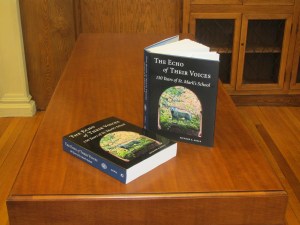 ok about history?” I have heard that question more times than I can count, along with its not so subtle companion: “Why?” Students past and present, who have struggled or who are struggling with research papers in school are usually the ones asking, finding it hard to believe that someone could see such a lengthy project through to the end. Then there are the casual online users who feel that google and Wikipedia are all they need, or those who feel that the past is behind us, over and done, and that studying yesterday is a waste of time when we should be looking forward to tomorrow. And sometimes folks are simply curious. In any event, the answers to these inquiries are both subtly complex and deceptively simple. (more…)

A Cake of Dante’s Inferno!
By William D’Angelo and Erica Christensen, VI Form
A Cake of Dante’s Inferno!
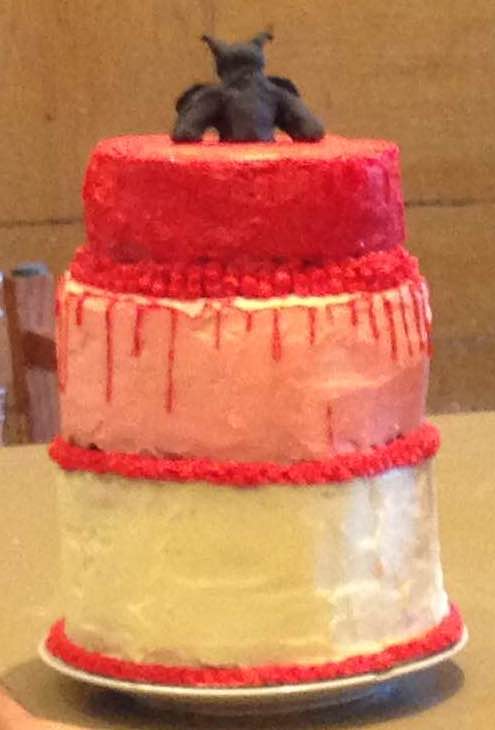 As the final project for our Independent Study reading and discussing Dante’s Divine Comedy, we baked and constructed a cake that featured the Circles of Dante’s “Inferno.” On the Saturday prior to Prize Day, during the Academic Showcase, we presented the cake. If students or faculty wanted a piece of cake, they needed to read all nine of our descriptions for each specific Circle and write down what Circle they would be in according to Dante. (The cake is designed upside down strictly for balancing purposes!)
The Yellow section (First through Fourth Circles): Limbo, Lust, Gluttony, Greed
The Pink section (Fifth through Seventh Circles): Wrath, Heresy, Violence
The Red section (Eighth and Ninth Circles): Fraud, Treachery
Below are our explanations for each Circle: (more…)

Civil Rights or “Cis”vil Rights?
By Anya Harter, VI Form
Civil Rights or “Cis”vil Rights?
Wars have been fought over as much. The right of every person to “life, liberty, and the pursuit of happiness” is the cornerstone of America’s foundation. The American Dream, in which so many so ardently believe, promises a job and an education for those who work hard and deserve it.
From this same belief originated federal laws regarding discrimination in the workforce. Title VII of the Civil Rights Act of 1964 states: “It shall be an unlawful employment practice for an employer … to discriminate against any individual with respect to his compensation, terms, conditions, or privileges of employment, because of such individual’s race, color, religion, sex, or national origin.” While, there is the workforce is not rid of discrimination, victims of this discrimination are protected under law. The reference to sex is even defined as including but not limited to “pregnancy, childbirth, or related
medical conditions” (Title). However, there exists a glaring hole. There is no mention of sexual orientation or gender in the anti-discrimination law. The term “sex” and “gender” are not equivalent. Sex = male and female ( biological differences: chromosomes, hormonal profiles, internal and external sex organs); Gender = masculine and feminine (sociological differences: characteristics that a society or culture deem as masculine or feminine) (more…)

Unjustly Accused: The Knights Templar or Philip the Fair?
By Matthew Flathers, VI Form
Unjustly Accused: The Knights Templar or Philip the Fair?
(A Product of the History Fellowship)
On March 18, 1314, Jacques de Molay, the twenty third and final Grand Master of the Knights Templar, was burned alive on a small island in the middle of the Siene.[1] Only a few years earlier, the organization under his command spanned across all of Europe and the Holy Land, and with the constant stream of donations pouring into the Order, there seemed to be no limit on what they could achieve. So the question remains: what chain of events could possibly have led to such a rapid destruction of an organization that once was a celebrated and glorious defender of the Christian Faith? (more…)
Schooling, Inquiry, and the Promise of the “St. Mark’s Saturdays” Program
By Nat Waters, Associate Dean of Academics
Schooling, Inquiry, and the Promise of the “St. Mark’s Saturdays” Program
One of the more transformative developments in my teaching practice in recent years has been the addition in each of my courses of essential questions — formulations that, in the words of Understanding by Design author Grant Wiggins, inspire, “deep thought, lively discussion, sustained inquiry, and new understanding as well as more questions.”
In that same spirit, I’d like to offer an essential question for this LEO piece on the exciting new developments in the St. Mark’s Saturdays program. Begin by thinking of your own high school experience, whether that is as immediate as May 2015, or farther removed than you would care to admit, even in close company:
“Which of the many academic lessons that comprise your high school experience are most memorable, most enduring, and most valuable to life and work in the ‘real world’?” (more…)

The Right to Death and The Death with Dignity Act
By Liz Swain, VI Form
The Right to Death and The Death with Dignity Act
Ethics and the law have clashed numerous times in history. What one believes is right and justifiable may not be so under federal law. Laws against physician assisted death have been heavily debated for with conflicting viewpoints. Physician assisted death occurs when a doctor prescribes a patient the necessary medication and dosage that would be lethal. The patient typically has a terminal illness and instead of slowly and painfully dying, the patient can choose to end his/her life in a peaceful and chosen way. Laws only permit physician-assisted death to be legal in five states: Oregon, Washington, Vermont, Montana, and New Mexico.[1] The Death with Dignity Act, allowing physician assisted death, should be ratified in all 50 states to allow someone to die on his/her own terms. (more…)

The Power of Grants in Student Development
By Camille Banson, VI Form and Ryan Lee, VI Form
Editor’s Note: The Matthews Educational Fund provides grants to students of any form who are good citizens and solid students. Grants are made for special needs such as tutoring assistance, special instruction, seminars, academic experiences of a national or international nature, and personal growth and advancement opportunities. Awards are based on merit and need as determined by a faculty committee. Last year, Camille Banson and Ryan Lee received the Matthews Fund Award to pursue their educational endeavor. Here is an overview of their experience.
Camille Banson:
Over the summer, I participated in a Boston University Summer Program. It ran for two weeks (more…)


 LEO
LEO 