
Home » Posts tagged 'History' (Page 13)
Tag Archives: History

My Presentism RANT
By Adam Jewell, History Faculty
My Presentism RANT
An immediate disclaimer: I am a flawed human; we all are. I am, however, probably flawed more than most. I attended six different colleges and have two degrees (one of them is NOT a doctorate). I routinely annoy every human I interact with, especially my poor wife. I very nearly cause severe (inadvertent) bodily harm to my son each and every day, but we laugh and shake it off so I assume all is well. In short, I mess up this game of life each and every day and therefore try to not pass any judgments (moral or otherwise) upon anyone. With that in mind, seriously, we all have a pretty damn good life. However, from what we all often say and hear on a daily basis, one would think we are living a life akin to Depression Era America or perhaps worse. I refer to this phenomenon as my own version of “presentism.” My idea strays from the normal definition of the term. Simply put, “presentism” in my discipline is interpreting the past through the moral concepts and lens of the present. Instead, I argue that a more tangible form of “presentism” exists (more…)

Video: Expressing Specific Details and Overall Picture in History
By Jane Watts, V Form
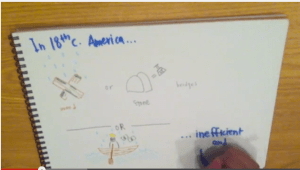 This year is my first year taking any history at St. Mark’s. Taking two histories my junior year, it’s been hard for me to keep up with so much material that we’re given to understand each class. I feel that using art to visualize and work with the material we learn provides me with a more comprehensive understanding of the general picture. In Advanced US History, I’ve recently done two assignments utilizing art. The first assignment was for the Technology project, (more…)

The Epic Hero: An Analysis of the Shields of Achilles and Aeneas in Comparison to Hesiod’s “Shield of Heracles”
By Matthew Flathers, VI Form
While the pseudo-Hesiodic Shield of Heracles is largely considered to be a poorly composed piece of poetry, criticized and deemed inauthentic by other antiquated authors[1], it is through its mimicry and plagiarism that it is able to provide valuable insight into Greek, and later Roman, heroism. This short, 450-lined recounting of the contest between Heracles and Cycnus is, as the title suggests, an ekphrastic work about the shield that Heracles bore in the fight. However, seeing as the poem is not particularly well written or unique, the focus of the work lies entirely in the description of the shield itself as opposed to the quality of the imagery used. While large portions of the text are paraphrased and even directly quoted sections of Homer’s Iliad,[2] other sections are indeed original

Your American Freedoms
By David Eacho, VI Form
In 1789, fed up with complaints from anti-federalists claiming that the brand new Constitution would strip all the rights and freedoms away from men, James Madison wrote a Bill of Rights: a series of Ten Constitutional Amendments that would protect all Americans from the potential tyranny of the government. While some of these rights do not seem useful in a modern day context, such as the Third Amendment right to refuse to give a soldier a bed in your home, or the Tenth Amendment, which merely delegates powers to the States, knowledge of your rights as an American citizen is crucial to the success of our society. (more…)

The Greatest Contraction of American Democracy
By Kolbe Renkert, V Form
The following speech was written in response to the prompt, “What event in history most contracted or expanded American democracy?” I chose to write about the Supreme Court case of Plessy v. Ferguson as the greatest contraction of American democracy.
The legalization of second-class citizenship. The legalization of inferiority among races. The legalization of segregation. The 1896 Supreme Court case of Plessy v. Ferguson was the greatest contraction of democracy in the history of the United States because it gave power to the majority, created inequality among all citizens, interfered with personal liberties, and increased further segregation in public institutions. American democracy includes the (more…)

The 5 Minute Professor
By David Baek, IV Form
In Ms. Millet’s AP World History class, students were given an opportunity to showcase a topic to their class that they had chosen themselves to teach, for an exercise called the “5 Minute Professor.” Such topics were, “How is steel made?” and “The philosophy of Adam Smith (capitalism).” Given approximately a week to prepare, I scrambled the Internet and books in the library to search for any information on the philosophy of Adam Smith and its impact in world history. Using all my free time, I was able to understand Adam Smith’s ideas by reading some of the articles in his major work, An Inquiry into the Nature and Causes of the Wealth (more…)
The Broken Pieces Made Into Germany
By Harrison Chapman, VI Form
In the spirit of No-Shave November, I feel inclined to honor some of facial hair’s greatest sponsors. Many leaders throughout history grew impressive beards and mustaches: Lincoln, Darwin, Roosevelt, Twain, and, of course, Chuck Norris. But, one man not only rocked a handle bar mustache incredibly well, but he was also able to unite the individual pieces of the broken Holy Roman Empire into what we now know as Germany. This man was Otto von Bismarck. (more…)
Notes from a History Research Paper Purist
By Caitlin Jones, History Faculty
Lately, I have been giving a lot of thought to the value of the traditional history research paper. Has the shift towards instantaneous, accessible information made historical research skills obsolete or has it made the role of the historian that much more important in wading through the sea of information that is readily available at our fingertips? In all of this discussion about global citizenship and twenty-first-century skills, is the history research process relevant and valuable? (more…)


 LEO
LEO 