
Home » Posts tagged 'History' (Page 12)
Tag Archives: History

Achieving the History of St. Mark’s—An Author’s Journey
By Nick Noble ’76, Communications Manager & Editor, School Historian
Achieving the History of St. Mark’s—An Author’s Journey
“Just how do you write a bo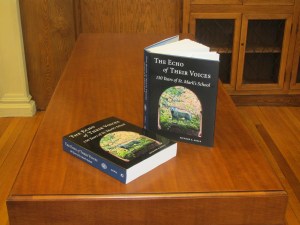 ok about history?” I have heard that question more times than I can count, along with its not so subtle companion: “Why?” Students past and present, who have struggled or who are struggling with research papers in school are usually the ones asking, finding it hard to believe that someone could see such a lengthy project through to the end. Then there are the casual online users who feel that google and Wikipedia are all they need, or those who feel that the past is behind us, over and done, and that studying yesterday is a waste of time when we should be looking forward to tomorrow. And sometimes folks are simply curious. In any event, the answers to these inquiries are both subtly complex and deceptively simple. (more…)

Civil Rights or “Cis”vil Rights?
By Anya Harter, VI Form
Civil Rights or “Cis”vil Rights?
Wars have been fought over as much. The right of every person to “life, liberty, and the pursuit of happiness” is the cornerstone of America’s foundation. The American Dream, in which so many so ardently believe, promises a job and an education for those who work hard and deserve it.
From this same belief originated federal laws regarding discrimination in the workforce. Title VII of the Civil Rights Act of 1964 states: “It shall be an unlawful employment practice for an employer … to discriminate against any individual with respect to his compensation, terms, conditions, or privileges of employment, because of such individual’s race, color, religion, sex, or national origin.” While, there is the workforce is not rid of discrimination, victims of this discrimination are protected under law. The reference to sex is even defined as including but not limited to “pregnancy, childbirth, or related
medical conditions” (Title). However, there exists a glaring hole. There is no mention of sexual orientation or gender in the anti-discrimination law. The term “sex” and “gender” are not equivalent. Sex = male and female ( biological differences: chromosomes, hormonal profiles, internal and external sex organs); Gender = masculine and feminine (sociological differences: characteristics that a society or culture deem as masculine or feminine) (more…)

Unjustly Accused: The Knights Templar or Philip the Fair?
By Matthew Flathers, VI Form
Unjustly Accused: The Knights Templar or Philip the Fair?
(A Product of the History Fellowship)
On March 18, 1314, Jacques de Molay, the twenty third and final Grand Master of the Knights Templar, was burned alive on a small island in the middle of the Siene.[1] Only a few years earlier, the organization under his command spanned across all of Europe and the Holy Land, and with the constant stream of donations pouring into the Order, there seemed to be no limit on what they could achieve. So the question remains: what chain of events could possibly have led to such a rapid destruction of an organization that once was a celebrated and glorious defender of the Christian Faith? (more…)

The U.S. Should Not Join the International Criminal Court (ICC)
By Isabelle (Minjae) Kim, III Form
The U.S. Should Not Join the International Criminal Court (ICC) (winner of the Ely Speech Prize–description at bottom of the article)
For centuries, humans have suffered from the dictatorship of the most tyrant leaders in the world. Since then, the international community decided that they should do something. And that ‘something’ turned out to be the ratification of the Rome Statute on July 17, 1998, bringing the International Criminal Court into effect on July 1, 2002. The ICC has gained a favorable reputation by many people, as its main goal is to promote universal justice through prosecuting those who are alleged criminals of human rights. However, the ICC is veiled with an image of peace and security,
preventing people from looking into the flaws that exist within the Court. Regardless of its mission for a good-cause, I strongly believe that the United States should not join the ICC, because the ICC violates national sovereignty and leaves the nation vulnerable to the decisions made by politically motivated ICC judges and prosecutors. (more…)

The Power of Historical Memories in Shaping Post-Civil War Events
By Joey Lyons, V Form
The Power of Historical Memories in Shaping Post-Civil War Events
What is democracy? Andrew Jackson said, “Democracy is majority rule, pure and simple.” In a democracy, those who are legally entitled to vote are supposed to be able to participate in the democratic process. After the Civil War, Americans resolved to include blacks in America’s democracy. The promise of this democratic expansion, however, was crushed after Reconstruction. Those who sought to reestablish white rule in the South, the Redeemers, disenfranchised African Americans. To enact this major contraction of American democracy, the Redeemers needed to alter the meaning of the Civil War. While the war was fought over conflicting viewpoints on federalism and
the morality of slavery, the Redeemers wanted to eliminate racial equality as one of the issues of the war. In order to do so, white southerners, despite losing the war’s battles, sought to win its memory. Southerners put forth the “Lost Cause” theory, whereby slavery was not seen as a cause of the war. (more…)
The Horrific Nazi Experiments During World War II
By Lucy Holland, VI Form
The Horrific Nazi Experiments During World War II
Presently, informed consent is a widely used and understood term – the process of receiving consent from patients before administering a medical intervention on them. But before a court case in 1957[1], only 58 years ago, informed consent was not required in medical practices, which meant that medical practitioners could do almost anything to their patients without them knowing or realizing that it was ethically wrong. In The Immortal Life of Henrietta Lacks, Henrietta’s cells were taken for a culture when she went into Johns Hopkins because of what the doctors eventually discovered was (more…)

Chalk Talk: My RANT on “Old” and “New” Pedagogy
By Adam Jewell, History Faculty
Chalk Talk: My RANT on “Old” and “New” Pedagogy
Ahhhh the smell of those white board markers, I love them, I just love them. If they do anything, they, at the very least, keep us from getting chalk all over us and having students ingest chalk dust like some sort of appetizer. It is my nostalgia for chalk that leads me to ponder something that keeps coming back to me like some sort of bad meal at every restaurant my wife and I ever go to. It is the practice of “chalk and talk” instruction. As the name entails, it is a practice as old as chalk, and well slate; I will confess I have no clue which came into use first. To be more exact, it is also as old as whenever one human sat and talked to another about something one of them was either curious about or “knew” more about. In essence, “chalk and talk” is a representation of the “old style” of teaching. (more…)

Biology Research Paper: Tuskegee Syphilis Study
By Conor Brockway, V Form and Damion Nsiah, V Form
Biology Research Paper: Tuskegee Syphilis Study
The first half of the 20th century was plagued by actions that are deemed unethical and frightening in today’s society. These actions included the spreading of the Jim Crow Laws, the rising of the KKK, and the speculation of the stock market, resulting in the Great Depression. Many Americans now know of these actions and condemn them. However, poor medical practices during this time period were often overlooked. Many doctors, without advanced equipment or proper safety guidelines, would perform procedures on living bodies to see what happened to them. These experiments were often completed without informed consent. One of the most unethical studies that came from the 1900’s was the Tuskegee Syphilis Study. (more…)


 LEO
LEO 