Home » Posts tagged 'Education'
Tag Archives: Education
Transpacific Scholars: A Journey Through the Boxer Indemnity
By: Daniel Guo, VI Form
Transpacific Scholars: A Journey Through the Boxer Indemnity
Editor’s Note: This paper was completed as part of a History Research Fellowship, a one-semester course available to sixth form students, where students write a historical research paper about their chosen topic.
Over the past two decades, the number of Chinese students in the United States has seen a remarkable surge, growing from a modest original number of around 20,000 students in 1991 to an enormous student body of more than 300,000 in 2021. Since 2009, Chinese students have consistently represented the highest portion of international students, making up nearly a third of all international students in American colleges and universities. These Chinese students choose to pursue a wide range of subjects and academic disciplines such as engineering, English, and law in the many different educational institutions that the United States offers, including prestigious universities such as Harvard and Yale. However, due to recent geopolitical tensions between China and the United States, the drive for Chinese students to study in the United States has diminished, with many turning to other prestigious schools in the United Kingdom and Europe instead.
This shift away from Chinese students in the United States is not just unique to the Chinese perspective: a Pew Research Center survey indicates that 55%, a majority of Americans surveyed, support limiting Chinese students studying in the United States. One in five Americans strongly supports limiting Chinese students in the United States. This situation is seemingly targeted specifically towards Chinese students, as the majority of Americans view international students favorably, with 80% of Americans expressing a positive opinion towards them.
(more…)Someone Has to Fail
By Brittney Brown, Mathematics and Science Faculty Member
Someone Has to Fail
Faculty-Submitted Note: This essay was to examine how St. Mark’s fits in with the trifecta of aims (social mobility, social efficiency, and democratic equality) that David Labaree described in his book “Someone Has to Fail”.
St. Mark’s, an elite private boarding school that proudly believes in their slogan “Intentionally Small, THINKING BIG,” claims to help students “develop a spirit of independence, innovation, and discovery” that prepares “them to lead lives of consequences” (St. Mark’s School, n.d.). For a school that was initially focused on the idea of social mobility, the expansion to include themes of democratic equality and social efficiency have not been implemented in the most beneficial way. When reading Labree’s Someone Has to Fail, the quote “the American system of education is highly accessible, radically unequal, organizationally fragmented, and instructionally mediocre” reminded me of St. Mark’s (Labaree, 2010). By attempting to encompass all the values of democratic equality, social mobility, and social efficiency, St. Mark’s appears to be subpar at all three.
One of St. Mark’s biggest selling points is centered around the idea of community. Creating a community that allows for a range of different perspectives also ties into the goal of students “living lives of consequence,” or gaining the skills necessary to participate in communities outside of St. Mark’s. Democratic equality, defined by Labree, “sees education as a mechanism for producing capable citizens” (Labaree, 2010). With a focus on community and being open to different perspectives is key to St. Mark’s approach to democratic equality. There is ample opportunity for students to gather together given that we meet as a whole school every school day. We give opportunities for students to participate in global studies with the goal that they become global citizens or gain a global perspective. There are community and student centered gatherings, such as Gray Colloquium (a speaker series with a discussion theme each year), or Community and Equity student meetings (where different topics are discussed), that give students the opportunity to participate. These are opportunities, not requirements, so every student is embodying a different interpretation of what it means to be a capable citizen. Without these requirements, how effective is the claim that students will gain a global mindset?
(more…)Flourishing with Standards-Based Grading
By Colleen Finnerty, History and Social Sciences Faculty Member, Class of 2011
Flourishing with Standards-Based Grading
Faculty-Submitted Note: This paper was written for the Master of Applied Positive Psychology program at the University of Pennsylvania. The task was to address the following question: Considering positive psychology’s aim to enhance human flourishing worldwide, how can the field make a significant impact on promoting healthy environments and institutions?
Traditional grading systems use grades as rewards for desired behavior and learning practices. These rewards come in the form of point values and percentages, and students work to maximize points or percentage. Grades incentivize achievement while undermining the value of effort and progress in the learning process (Olson, 1996). Traditional grading systems also foster competition among students rather than promoting a learning community. Students see grading as a “zero-sum” practice such that one student’s success is connected to another student’s failure because of curves and grade distributions (Olson, 1996). A common practice among high schools in the United States is to establish a class rank using cumulative grade point averages. Class ranks are offered to college admissions officers and used to award prizes upon graduation such as valedictorian. However, class rank does little to actually motivate students to become lifelong learners and instead pits students against each other in the classroom (Guskey, 2013). Traditional grading systems discourage risk-taking and creative learning; former valedictorians are often hardworking in their respective professions, but they are not the ones to take chances and propose innovative ideas (Arnold, 1995). To promote flourishing among the next generation, schools have an obligation to examine their grading policies by using tenets of positive psychology.
Educators who see themselves as tasked with identifying talented students do so with teaching, assessment, and grading practices that accentuate differences between students. Educators who see themselves as tasked with cultivating talent define clear learning objectives and work to ensure that all students have the opportunity to reach the learning objectives (Guskey, 2013). Students with higher levels of happiness and well-being are more likely to succeed in academic settings, feel more competent, and have more confidence than their peers (Clarke, 2020). To help students excel in the classroom, educational institutions need to implement policies and practices that enhance student well-being. Mandated use of standards-based grading (SBG) in primary and secondary schools would improve student well-being and develop lifelong learners.
(more…)Education in Underfunded Zimbabwean Societies
By Charlene Tariro Murima, VI Form
Education in Underfunded Zimbabwean Societies
Editor’s Note: This project was made possible with the support of the Class of 1968 V Form Fellowship. At their 25th reunion, the Class of 1968 created a fund to provide grants to V Form students for independent study during the school year or, more commonly, during the summer between V and VI Forms. Their intent in establishing this fund was to reward independent thinking, ingenuity, and planning and to encourage the student exploring non-traditional fields of inquiry or using non-traditional methods of investigation.
Student-Submitted Note: To encourage a more globally-minded perspective and understanding of diverse educational practices, I received a grant through The Class of 1968 V Form Fellowship and traveled back to Zimbabwe during the summer of 2022. I conducted anonymous and in-person interviews. In these interviews were students and teachers informing me more about the country’s education system.
Student-Submitted Disclaimer: This article contains mentions of abortion and sexual abuse.
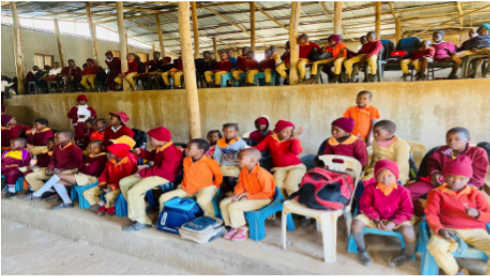
Over the summer of 2022, I traveled back to Zimbabwe to work on a documentary called Education in underfunded towns of Zimbabwe such as Dzivaresekwa, Concession, Mazowe, and Kuwadzana with the goal to educate my peers and schoolmates about some of the challenges students in Zimbabwe face. To make this study possible, I received a grant from the St. Mark’s Class of 1968 V Form Fellowship. I was able to visit many schools that lacked government funding or had limited resources, and I conducted anonymous and in-person interviews with students and teachers. I learned that the education system in Zimbabwe encompasses 7 years of primary school and 6 years of secondary school. It runs from January to December. The school year is a total of 3 terms with a one-month break, totaling 40 weeks per year. I asked a few students in person and anonymously online what they thought about the country’s education system and what they hope to change. Recurring themes of sparse resources and perpetual sexual abuse from those meant to educate them surfaced.
Building a Social Justice Mindset: Parents as Partners Presentation
By Dr. Colleen Worrell, Directer of the Center for Innovation in Teaching and Learning
Building a Social Justice Mindset: Parents as Partners Presentation
The following video is a recording of Dr. Worrell’s Parents as Partners presentation on building a social justice mindset.

The Effect of Visual Support on Learning: A Psychology Case Study
By William Osborne and Julian Yang, VI Form
The Effect of Visual Support on Learning: A Psychology Case Study
Abstract
Memorization plays a major role in education, especially throughout grade school and middle school. Despite this, many teachers support studying for memorization based tests by only repeating the information needed until it is stuck in the student’s brain. This study examines the positive effect visuals have on the brain’s ability to memorize words. Past experiments have found that the inclusion of images with text would increase a person’s ability to memorize and recall information. To test this, participants were given a short period of time to memorize ten words and then recall them. The same process was then repeated, but with a different list which also contained images of the words. The results showed that participants’ ability to memorize was facilitated with the use of images. One possible explanation is that the brain is able to mentally picture the image when remembering the words, giving it a concrete example to pull from instead of only a few letters on a page.
Keywords: Memorization, Visual Learning, Information Recall, Learning Strategy
(more…)
Reflections on Coates’ Education in Between the World and Me
By Daniella Pozo, IV Form
Reflections on Coates’ Education in Between the World and Me
When one has never been exposed to the world at large, ignorance can be an easy trap to fall into. Ta-Nehisi Coates takes the difficult steps to awaken himself, learn about his place in the world, and overcome his ignorance. Samori Coates is Ta-Nehisi Coates’s son whom he had with Kenyatta Matthews, a girl he met at The Mecca. The Mecca is the coalition of brilliant black individuals at Howard University where Coates studied for a number of years. Here, Coates experienced three life-changing events: he had a son, he read as many books as he could get his hands on, and he interacted with black people who are different from him. In the memoir Between the World and Me, Coates embarks on a journey of self-growth with the help of Samori Coates and The Mecca showing him compassion and diversity within the black community, as well as forcing him to question his perception of the world. His reflection on this journey invites each reader to contemplate his/her own viewpoint.
(more…)
Embracing Global Citizenship in Sri Lanka
By Anishka Yerabothu, VI Form
Embracing Global Citizenship in Sri Lanka
Editor’s Note: This article was previously published by Anishka Yerabothu and Educate Lanka in Medium. It is republished here with permission.
This summer, I traveled to Kandy, Sri Lanka for three weeks to volunteer with the Educate Lanka Foundation. I first came across Educate Lanka when I began researching global citizenship opportunities through my high school — St. Mark’s School— last fall. The opportunity with Educate Lanka immediately appealed to me and my parents because my great-grandparents lived in Sri Lanka for 40 years, leaving before the civil war that ravaged the country broke out in 1983. They carried with them their love for the country, the people, and the cuisine, and they shared that love with the entire family. My grandmother still prepares traditional Sri Lankan dishes we enjoy at home.
As part of my research into the opportunity with Educate Lanka, my family and I watched the TEDx Talk of Educate Lanka’s founder — Manjula Dissanayake; his message about creating universal opportunities resonated with my family. After conversations with Dr. Laura Appell-Warren, the Director of Global Citizenship at St. Mark’s, and Mr. Dissanayake about volunteering with Educate Lanka, we finalized the plan for my travel in June. We bought a plane ticket and arrangements for my stay in Sri Lanka were made in coordination with Educate Lanka staff.
On the morning of April 21, 2019, however, we woke to the shocking news of the Easter Sunday terrorist bombings at Sri Lankan churches and hotels.
(more…)

 LEO
LEO 