Home » Posts tagged 'Community'
Tag Archives: Community
Someone Has to Fail
By Brittney Brown, Mathematics and Science Faculty Member
Someone Has to Fail
Faculty-Submitted Note: This essay was to examine how St. Mark’s fits in with the trifecta of aims (social mobility, social efficiency, and democratic equality) that David Labaree described in his book “Someone Has to Fail”.
St. Mark’s, an elite private boarding school that proudly believes in their slogan “Intentionally Small, THINKING BIG,” claims to help students “develop a spirit of independence, innovation, and discovery” that prepares “them to lead lives of consequences” (St. Mark’s School, n.d.). For a school that was initially focused on the idea of social mobility, the expansion to include themes of democratic equality and social efficiency have not been implemented in the most beneficial way. When reading Labree’s Someone Has to Fail, the quote “the American system of education is highly accessible, radically unequal, organizationally fragmented, and instructionally mediocre” reminded me of St. Mark’s (Labaree, 2010). By attempting to encompass all the values of democratic equality, social mobility, and social efficiency, St. Mark’s appears to be subpar at all three.
One of St. Mark’s biggest selling points is centered around the idea of community. Creating a community that allows for a range of different perspectives also ties into the goal of students “living lives of consequence,” or gaining the skills necessary to participate in communities outside of St. Mark’s. Democratic equality, defined by Labree, “sees education as a mechanism for producing capable citizens” (Labaree, 2010). With a focus on community and being open to different perspectives is key to St. Mark’s approach to democratic equality. There is ample opportunity for students to gather together given that we meet as a whole school every school day. We give opportunities for students to participate in global studies with the goal that they become global citizens or gain a global perspective. There are community and student centered gatherings, such as Gray Colloquium (a speaker series with a discussion theme each year), or Community and Equity student meetings (where different topics are discussed), that give students the opportunity to participate. These are opportunities, not requirements, so every student is embodying a different interpretation of what it means to be a capable citizen. Without these requirements, how effective is the claim that students will gain a global mindset?
(more…)
Extending Community During Social Distancing: Remote Experiential Learning in Spanish
By Mr. Charlie Sellers, Spanish Faculty; Lindsay Davis, V Form; Tate Frederick, V Form; and Sydni Williams, IV Form
Extending Community During Social Distancing: Remote Experiential Learning in Spanish
Spanish is not for the classroom, and it is my hope that, after this year, all of my students will feel empowered to use their Spanish beyond St. Mark’s.
– Mr. Charlie Sellers
During the final three weeks of Remote Learning, Spanish 4 students worked on a multi-step project called Estrechando Lazos/Making Connections. I asked students to pick a topic that in some way related to one of the units that we studied during remote learning: COVID-19 in the Spanish-Speaking World; Immigration: Assimilation and Alienation; and The Food Supply: the Migrant Farmworker in the United States. Students were asked to research the topic and find two to three relevant sources. Then, they tried to make contact with at least one person who is knowledgeable in the topic area. Students composed emails in Spanish to set up interviews using Zoom.
Experiential Learning is a large part of what we do at St. Mark’s, and what I have learned from participating in experiential programs at our school influenced how I set up the project. I relied substantially on what I learned from last year’s Fifth Form Lion Term Leaders, Colleen Worrell and Kim Berndt: Design Thinking; making contacts outside of the school; giving students choice in choosing topics; guiding them along the way; and helping them present their most salient takeaways in a final demonstration of learning. In the final week of school, students presented a culminating project of their choice that showed what they had learned. The students’ work exceeded my expectations.
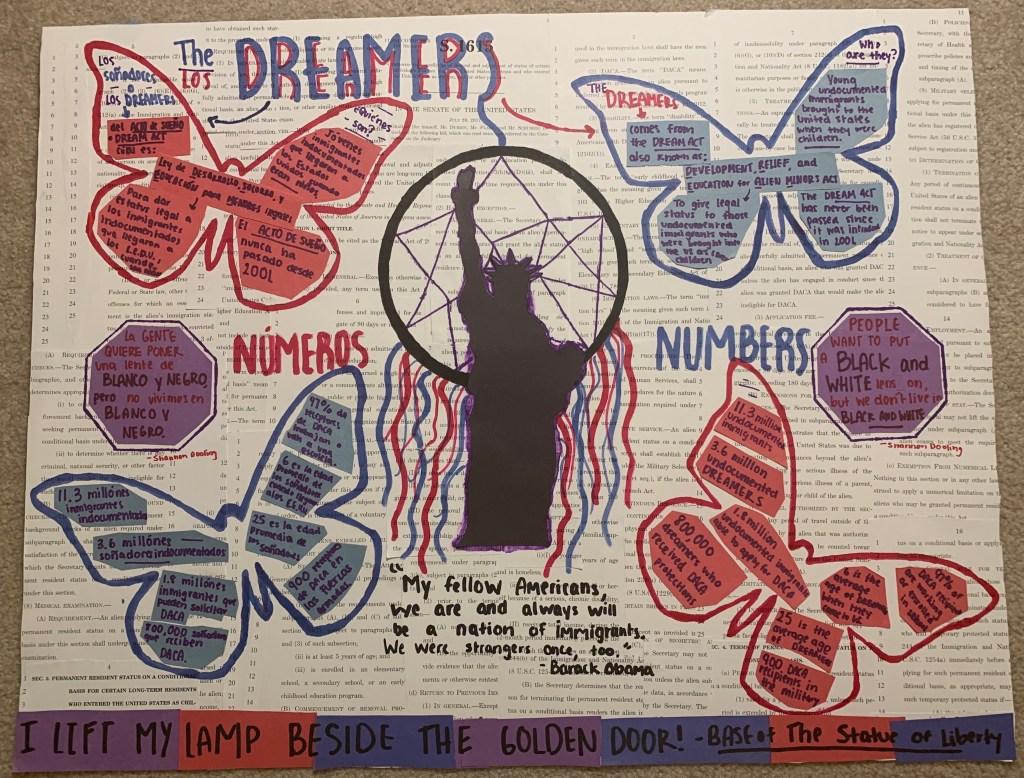
The projects were diverse and relevant to the students’ interests. Fifth Former Sydney Williams interviewed both a family friend who is an immigration attorney and WBUR immigration reporter Shannon Dooling about the Dreamers and the Deferred Action for Childhood Arrivals (DACA) program. For her final product, she created a collage about the Dreamers and DACA. She wrote facts that she had learned from her interviews and research in images that she cut out of monarch butterflies and two stop signs. A symbol of the Dreamers, monarch butterflies pass freely over the US/Mexico border. She also included a dream catcher behind an image of the Statue of Liberty, and she superimposed these images on top of a background of the Dream Act.
A Community of Language Learners
By Mr. Charlie Sellers, Modern Languages Faculty
A Community of Language Learners
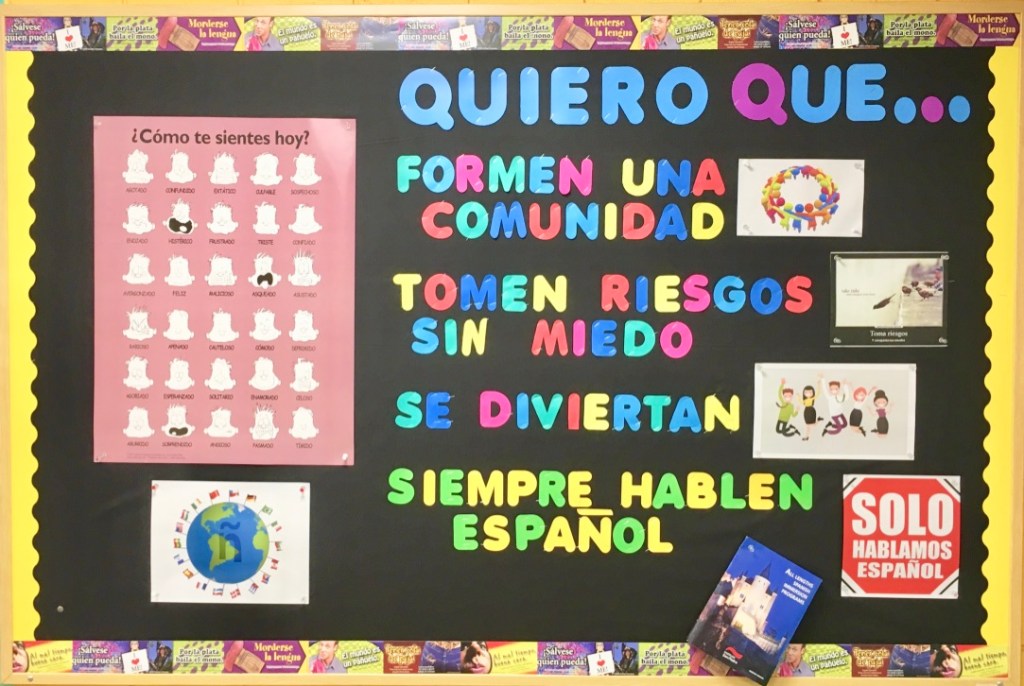
“¡Manos con manos, dedos con dedos, puños, palmas, pulgares, dedos índices, dedos meñiques… descanso!” I orchestrate these commands while the class stands in a circle giving each other high fives and joining fingers, fists, palms, thumbs, index fingers, then they wait for the next direction. “Espaldas con espaldas.” Everyone goes back to back. “¡Cinco, cinco, diez, diez, codos, codos, pies, pies!” The students face their conversation partners, and again give high fives, tens, and knock elbow, elbow, foot, foot. They wait for the prompt to respond to an attention-grabbing hook about a brief, animated short film about Día de los muertos. On my cue in groups of two, the students start listing elements that we have studied from Día de los muertos that they saw in the video, which is a novice skill (ACTFL). “¡Díez al revés!” The kids give backwards high fives to their classmates who are standing behind them in the circle, turn to face each other, and, again, responding to another prompt, and they start narrating using the past tenses to recount what happened in the video, addressing Intermediate-High Level discourse (ACTFL).
More Important Than My Fear
By Payton Nugent, VI Form
More Important Than My Fear
Do you really think anyone cares?
During my announcement to the school, I hear this lone internal voice.
What you’re trying to do is stupid and doesn’t matter.
I have tried to shake this voice from my head, but it keeps coming back. During every announcement I make for the Gender Sexuality Alliance, that voice represents every student who is rolling his or her eyes. That voice represents every student who thinks issues of gender identity and sexuality are nonexistent because “there are no gay people at St. Mark’s.” For some, I will never be able to change their minds. Whenever I make these announcements, I wonder why I run for head of the GSA if this voice is always pestering me. (more…)
Festina Lente: Reflections on Teaching and Gardening
By Heather Harwood, Classics Faculty
Festina Lente: Reflections on Teaching and Gardening
This past spring and summer, I was once again actively involved in the St. Mark’s Community Garden Project. With the help of five students last spring and with the committed labor of several St. Mark’s faculty during the summer, the garden continued to expand and flourish into its fourth season. It provided all of us who participated with an abundance of delicious and nutritious food and was a quiet, reflective refuge where I could escape any given sunny morning to harvest my thoughts about the past school year and think about the upcoming one. (more…)


 LEO
LEO 