
Home » Posts tagged 'Class of 1968 V Form Fellowship'
Tag Archives: Class of 1968 V Form Fellowship
Chicanismo: Examining Mexican-American Culture, History, and Perspectives Through Photography
By Jonathan Hernández, VI Form
Chicanismo: Examining Mexican-American Culture, History, and Perspectives Through Photography
Editor’s Note: This project was made possible with the support of the Class of 1968 V Form Fellowship. At their 25th reunion, the Class of 1968 created a fund to provide grants to V Form students for independent study during the school year or, more commonly, during the summer between V and VI Forms. Their intent in establishing this fund was to reward independent thinking, ingenuity, and planning and to encourage the student in exploring non-traditional fields of inquiry or using non-traditional methods of investigation.
Student-Submitted Note: This past summer, I took part in The Class of 1968 V Form Fellowship and used my grant funds to travel to Los Angeles to look at Latinidad and Mexican-American identities and spaces through a photographic lens. I compiled what I learned (in addition to a bit of research I completed) in an academic reflection uploaded below.
“We cannot seek out achievement for ourselves and forget about progress and prosperity for our community… Our ambitions must be broad enough to include the aspirations and needs of others, for their sakes and for our own.” — Cesar Chavez.
Chicana/o/x or Xicana/o/x (both pronounced the same way) refer to persons of Mexican descent who grew up in the United States. The experiences of these Chicana/o/x persons are notably different from the experiences of simply American or Mexican individuals as neither identity has wholly encapsulated their background. Chicanismo, what this grant project was built around, is pride in one’s Chicana/e/o/x heritage. With the completion of this project, it is my hope to share what I have learned about the spaces I visited to provide insight into Mexican-American history, culture, and perspectives.
It is believed that Chicanos descend from indigenous groups who lived in Aztlán – the American Southwest region encompassing Arizona, California, Texas, New Mexico, Colorado, and parts of Oklahoma. As part of Spain’s colonial efforts, a racial hierarchy was instituted through a caste system called the “Castas” system. The Castas system unlike America’s system of race accounted for cultural mixing and recognized that Spain’s colonization of the Americas promoted cross-cultural interactions and allowed different groups of people to interact, trade, and marry with each other. Yet, the Castas system did not only organize persons based on their outward appearance but also on their parents’ individual races. For instance, a child with a West African father and Indigenous mother would most likely work as a laborer or farmer. Still, a child with an Anglo father and Meztic mother would most likely live an educated noble life. In fact, the practice of interracial marriage was so popular or so prominent that in the First Census of Los Angeles in 1978 a significant majority of the citizens identified as Mestizaje or of “mixed blood” (Webber 33-34). Thus, for many Mexicans and Latinos, it has proven difficult to identify wholly with one race over another because of interracial marriage and mixing throughout the decades.
After the Mexican Cession and the signing of the Treaty of Guadalupe Hidalgo, the US gained territory in what is today the American Southwest. In states like Texas, New Mexico, California, Colorado, Arizona, and Nevada which belonged previously to Mexico (and before that the Native American peoples in the region), about one hundred thousand people who decided to stay in the territories became U.S. citizens. Thus, began the formation of the Mexican-American identity.
(more…)Snowballing Towards Anti-Ethnic Homogeneity
By Steven Zhang, VI Form
Snowballing Towards Anti-Ethnic Homogeneity
Editor’s Note: This project was made possible with the support of the Class of 1968 V Form Fellowship. At their 25th reunion, the Class of 1968 created a fund to provide grants to V Form students for independent study during the school year or, more commonly, during the summer between V and VI Forms. Their intent in establishing this fund was to reward independent thinking, ingenuity, and planning and to encourage the student in exploring non-traditional fields of inquiry or using non-traditional methods of investigation.
Student-Submitted Note: Over my Junior year, I embarked on an ambitious research project rooted in personal experience. Eight years ago, I left my town’s Asian church, noticing over time that older friends were departing too. What prompted so many people with similar backgrounds to collectively leave? I dove into academic research. I exhausted every accessible paper, emailing professors for copies when articles weren’t free. I spent months interviewing and writing, dedicating 2-3 weekday hours and 4-8 weekend hours. It was incredibly hard to conduct research all by myself. I submitted an abstract summarizing my findings to UC Berkeley’s conference on Asian Pacific American religions, and was accepted based on my paper and my paper’s abstract.
Abstract
Despite recent attention on second-generation Asian American Christians, many racialization and ethnicization theorists often neglect the migration of second-generations from mono-ethnic churches to multi-ethnic churches. Through an analysis of the oral histories of nine East Coast, American-born, East Asian college students, my paper argues how race and cultural factors in ethnic, predominantly white, and multi-ethnic churches influence second generation students’ desire for diverse congregations. This study contends that due to family pressure on youth and overbearing cultural values in an ethnic church, second generations avoid Asian-homogenous religious environments and their parents’ ethnically bounded faith. Leaving instead for predominantly white churches, they find that cultural awareness on issues of marginalization is lacking. In both churches, second generations grow averse to homogeneous environments as minorities with unique cultural differences. In college, they resolve the desire for heterogeneous religious environments through the diverse college campus that offers religious autonomy and a religious buffet of ministries. Among the various options, the multi-ethnic ministry especially appeals to second generations by creating a minority-focused space infused with different perspectives. My paper uncovers a pattern of religious attendance among second-generation Asian Americans, analyzing how, when, and why religious diversity in congregations is vital.
Paper presentation
Introduction
My paper focuses on second-generation Asian Americans who attend multi-ethnic churches and explores their motivations for desiring and attending diverse congregations.
I employ a snowball metaphor to demonstrate how different factors combine to create a desire for diversity. The “compounding factors” to the snowball of anti-homogeneity are family pressure that creates desires for separation and independence, overbearing cultural values that create a dislike for homogeneous environments, reduced marginalization that creates a desire for a diversity of members, and a desire for diverse theology. This snowball of anti-homogeneity stops rolling after entering college, where the accumulation is resolved through the diverse college campus that offers religious autonomy, a religious buffet of ministries, and more diverse perspectives.
My methodology was emailing and networking. I emailed nine East Coast, East Asian, college students on college campuses and college graduates from nearby multi-ethnic churches to ask them these questions.
Before I go into my findings, I would like to provide a literature review.
As many researchers have noted, second generations embark on the silent exodus, a mass migration away from their mother churches. They leave because of cultural differences between generations and intergenerational leadership difficulties. The question of where they go has been answered by numerous authors who argue that second generations stay in ethnic and racial enclaves. They either head to Asian American ministries, return to their ethnic churches, or pave a new pan-Asian path, which although different from their parents, often carries mono-ethnic notions.
(more…)Pursuing My Passion for Finance with the Help of The Class of 1968 V Form Grant
By Kanav Sahani, Class of 2023
Pursuing My Passion for Finance with the Help of The Class of 1968 V Form Grant
Editor’s Note: This project was made possible with the support of the Class of 1968 V Form Fellowship. At their 25th reunion, the Class of 1968 created a fund to provide grants to V Form students for independent study during the school year or, more commonly, during the summer between V and VI Forms. Their intent in establishing this fund was to reward independent thinking, ingenuity, and planning and to encourage the student in exploring non-traditional fields of inquiry or using non-traditional methods of investigation.
Student-Submitted Note: I received the Class of 1968 V form grant so that I could attend a summer program at Bentley University called Wall Street 101.
I chose to attend the Wall Street 101 course at Bentley University because it provided me with a unique opportunity to pursue my passion for finance and experience firsthand the dynamic environment of a real actual trading room, unlike any other program available today.
I developed a keen interest in finance after I watched a Youtube video featuring the renowned Warren Buffett. In the video, Buffet recommended reading The Intelligent Investor by Benjamin Graham. Since then, I have enhanced my financial knowledge through books, professionals, internships, Youtube videos, and courses at Wharton and Georgetown. I wanted to share my knowledge, and to do so, I founded the finance club at my former school, Fay, and took on a leadership role in the finance club at St. Mark’s, known as SM Finance. The courses at Bentley taught me three topics that my previous research had not to fully elucidated: Stock Market & Investment Research, Portfolio Management, and Macroeconomy and Financial Markets. I plan to become an investment banker, and this course gave me an overview of all the needed knowledge.
My daily schedule involved attending a class with a professor who delivered us a unique lesson every day, listening to watching a guest speaker who shared valuable insights on finance-related topics, and collaborating with my group on our capstone project.
(more…)Increasing Accessibility in the Literary Community with the V Form Fellowship: The Aurora Journal
By Sophie Chiang, VI Form
Increasing Accessibility in the Literary Community with the V Form Fellowship: The Aurora Journal
Editor’s Note: This project was made possible with the support of the Class of 1968 V Form Fellowship. At their 25th reunion, the Class of 1968 created a fund to provide grants to V Form students for independent study during the school year or, more commonly, during the summer between V and VI Forms. Their intent in establishing this fund was to reward independent thinking, ingenuity, and planning and to encourage the student in exploring non-traditional fields of inquiry or using non-traditional methods of investigation.
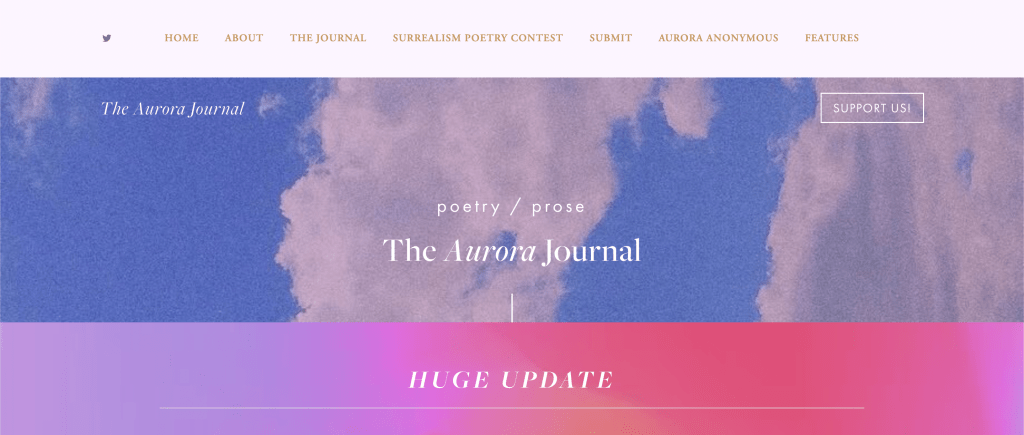
When I created The Aurora Journal (theaurorajournal.org) two summers ago, I just planned to publish my friends’ writing for fun. Literary journals were everywhere–all one had to do was submit their poetry and prose to them and hope their writing would be accepted and published. So never did I imagine that my own Journal would be able to reach thousands of submissions and be featured in news sites and blogs–a testament to the passion of our contributors. But when I first started gaining traction, I knew I wanted to do something more with my platform than just publishing writers. There exists a significant disparity gap in the writing world, in which cisgender, wealthy, educated white males dominate. With the support of the V Form Fellowship and many writer friends, The Aurora Journal has been able to make a positive impact in promoting inclusivity and accessibility in the writing community.


 LEO
LEO 