
Home » Season 2 (Page 3)
Category Archives: Season 2

Female Value: Dead in the Ashes of McCarthy’s The Road
By Marissa Huggins, V Form
Female Value: Dead in the Ashes of McCarthy’s The Road
In a post-apocalyptic world, the way of survival is quite literally “every man for himself.” The few humans that survive the apocalypse are forced back to their primitive states of being and live in constant fear of death. Some survivors, known as “the bad guys,” change their perception of human life and become morally limitless with their methods of survival. The “bad guys” either kill or capture people, depending on the perceived threat or benefit. Thus, the post-apocalyptic world’s culture is one where everyone’s purpose is to sustain his or her own life. Unlike most of the survivors in McCarthy’s The Road, the father and son have a co-dependent relationship that often promotes their survival. While the father may have been upset that his wife killed herself, his wife was wise to end her life and escape her life of imprisonment. (more…)

The Right to Death and The Death with Dignity Act
By Liz Swain, VI Form
The Right to Death and The Death with Dignity Act
Ethics and the law have clashed numerous times in history. What one believes is right and justifiable may not be so under federal law. Laws against physician assisted death have been heavily debated for with conflicting viewpoints. Physician assisted death occurs when a doctor prescribes a patient the necessary medication and dosage that would be lethal. The patient typically has a terminal illness and instead of slowly and painfully dying, the patient can choose to end his/her life in a peaceful and chosen way. Laws only permit physician-assisted death to be legal in five states: Oregon, Washington, Vermont, Montana, and New Mexico.[1] The Death with Dignity Act, allowing physician assisted death, should be ratified in all 50 states to allow someone to die on his/her own terms. (more…)

The Power of Historical Memories in Shaping Post-Civil War Events
By Joey Lyons, V Form
The Power of Historical Memories in Shaping Post-Civil War Events
What is democracy? Andrew Jackson said, “Democracy is majority rule, pure and simple.” In a democracy, those who are legally entitled to vote are supposed to be able to participate in the democratic process. After the Civil War, Americans resolved to include blacks in America’s democracy. The promise of this democratic expansion, however, was crushed after Reconstruction. Those who sought to reestablish white rule in the South, the Redeemers, disenfranchised African Americans. To enact this major contraction of American democracy, the Redeemers needed to alter the meaning of the Civil War. While the war was fought over conflicting viewpoints on federalism and
the morality of slavery, the Redeemers wanted to eliminate racial equality as one of the issues of the war. In order to do so, white southerners, despite losing the war’s battles, sought to win its memory. Southerners put forth the “Lost Cause” theory, whereby slavery was not seen as a cause of the war. (more…)

Babies Are Babies: Multiple Viewpoints on IVF
By Faith White, VI Form
Babies Are Babies: Multiple Viewpoints on IVF
My older siblings are twins, scientifically made in a lab, test tube babies. Scientists wearing white coats created them, in a Petri dish. Just like 4 million other children, they would not be here without science and medicine. Despite its many success stories, however, IVF has brought about many ideological controversies involving religion, ethics, and socioeconomics. But had it not been for my IVF siblings and my mother’s reproductive system resetting, I am not sure that I would ever be born. The question remains, however, should a couple that is struggling to conceive for one reason or another, but is able to pay to use IVF to have the baby that they have always wanted, benefit while (more…)
Please Comment–Should Byblis Be Pitied, Condemned, or Both?
By Allegra Forbes, V Form
Please Comment–Should Byblis Be Pitied, Condemned, or Both?
Click Here for Allegra’s Ovid Website!
This past month the Latin III H class read and translated various chapters from Ovid’s narrative poem Metamorphoses, in which the author gives subtle social commentary on Roman politics and morals through his adaptations of metamorphosis myths from the Hellenistic tradition. As a final project for the unit, I created this website to display my work on the myth of Byblis, the tragic tale of a river nymph consumed with lust for her twin brother Caunus. When I finished my first draft of the translation I was still torn as to whether tormented Byblis should be pitied or condemned (or perhaps both?), so I added a survey page to the website so that others can contribute their opinions on the matter.
Please comment! I would love to publish a compilation of different people’s answers. (more…)

Self Obligation, Patriotic Obligation, or Family Obligation? I’m with Antigone
By Abby Peloquin, IV Form
Self Obligation, Patriotic Obligation, or Family Obligation? I’m with Antigone
Throughout Antigone, the question of what is most important in the lives of the characters varies greatly. Creon professes his deepest devotion to his country through his actions concerning Polynices and Antigone; Antigone, on the other hand, remains steadfast in her beliefs in family as she sacrifices her life and marriage for the sake of burying her brother. I mirror the meritorious attitude of Antigone – my family, more than any material or human law–is the most essential part of my life. They are the basis of my existence, the platform upon which I draw myself together and carry on my journey of life, and the arms that hold me and guide me through the turmoil set before me. (more…)

Through a Different Lens – A Book, Blood, and Altruism: Thinking About Philanthropy
By William Bagley, Advancement Office
Through a Different Lens – A Book, Blood, and Altruism: Thinking About Philanthropy
On a corner in Cambridge in 1974, a day before taking my graduate degree, a favorite professor stopped me and offered a book. He described it as “something you have to read.” Though I had visions of reading a Trollope novel on a beach on Cape Cod, I could not say no. The book, written by Richard Titmuss, changed my life. Its title is The Gift Relationship.[1]
In the late 1960’s, Titmuss was a professor at the London School of Economics. His academic interests would lead him to study philanthropy – but in a very distinctive way.
Rather than look at philanthropy expressed as gifts of money, he looked at philanthropy in the (more…)

The Orchestra Coalesces (incl. a video of “Ashokan Farewell”)
By Jonathan Qu, VI Form
The Orchestra Coalesces (incl. a video of “Ashokan Farewell”) (click on photo or scroll to bottom for the video link)
Have you ever wondered what it was like to do four things at the same time? Well, all members of the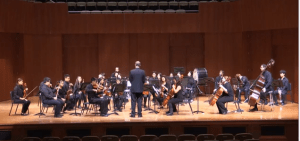 orchestra do. To effectively coalesce and produce a song that is pleasing to the ear, members must read the music, translate the music, play the music, and then listen to the music. This may not seem difficult at first, but simply playing the music and then listening to the music takes a lot of skill. Take the cello for example. Not only do you have to translate the notes on the page, but you also have to pay attention to what kind of combination those notes tell your fingers to do. You then also have to keep in your mind how you (more…)


 LEO
LEO 