
Home » 8th Season: 2020-2021 (Page 4)
Category Archives: 8th Season: 2020-2021

Science Site Analysis: A Mountain School Project
By Kendall Sommers, V Form
Science Site Analysis: A Mountain School Project
Student Note: This fall, I took a semester off from St.Mark’s and attended a semester school in Vershire, Vermont called The Mountain School. It’s a school focused on outdoor education and connection. We had two required courses, English and Environmental Science. After each unit in e-sci, we would have a final reflection where we wrote chapters on all the topics we had covered. The point of this project was to have a book at the end of the course containing all the content we had learned. Included below is my 3rd chapter, my science site. This unit was a little different from the others; we picked a place in the woods on campus and analyzed it over the course of the fall months. The idea of this project was to learn to be independently observant and develop our scientific analytical skills. Also, it connects to the school’s mission statement regarding building a connection to a place. The project below included my description of my site, my map and timeline I created, and my hypothesis regarding the history of the site.
Chapter 3: Science Site Analysis
Directions: To get to my center point you must first sign out on the board with a faculty member (rule number 2!) and then begin walking on the inner loop clockwise. Continue along the loop until you reach Siberia, then take a left onto the trail leading up to pine top. Here, the grass will be a bit taller and you will see a tree on the left of the path with a really long branch that turns up at a right angle. Now, walk uphill on this path until you reach another path going off to the right. Follow this path downhill for about 60 paces until you reach my site’s center point! You will know you have arrived if the trees around you are mainly coppiced white pines and to your right (south west) there is a clearer section of the woods with no canopy, but filled with ferns. The site is on a hill facing the SE, so check your compass. Also, far to the left you will see the canopy begin to change, but most of the area around you should be filled with those big coppiced white pines, white ash trees, and sugar maples. Are you there? Wonderful! There is so much more at my site to discover, let’s dive in!
(more…)
Custom Shoes with the Fifth Form Fellowship
By Leila Frederick, VI Form
Custom Shoes with the Fifth Form Fellowship
Editor’s Note: This project was made possible with the support of the Class of 1968 V Form Fellowship. At their 25th reunion, the Class of 1968 created a fund to provide grants to V Form students for independent study during the school year or, more commonly, during the summer between V and VI Forms. Their intent in establishing this fund was to reward independent thinking, ingenuity, and planning and to encourage the student exploring non-traditional fields of inquiry or using non-traditional methods of investigation.
This past Summer I utilized the Fifth Form Fellowship grant to pursue a new art medium: painting custom shoes. I’d held an interest in painting shoes for a while, mostly because I had been seeing more and more Youtube videos of artists starting to paint wearable art. Being a bit of a sneaker fan, I watched a lot of those videos, especially over quarantine. Thanks to this grant, I was able to purchase some preliminary shoes, paints, brushes, and shoelaces to begin working on some shoes of my own!
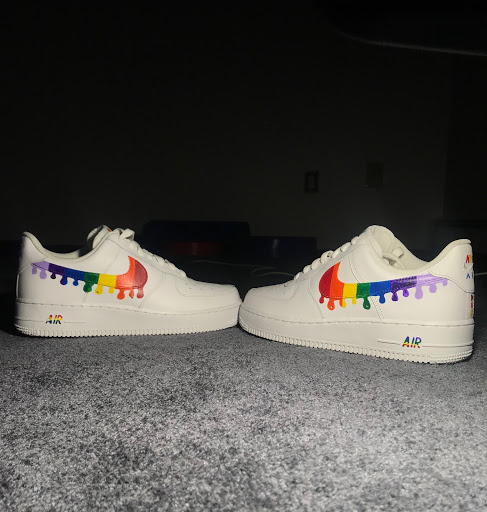
I began by starting an Instagram account (@first_soup_productions) in order to easily communicate with customers. When someone was interested, they would directly message me with some general ideas.
(more…)
The Civil War & A Microcosm of Jewish History
By James Nichols-Worley, IV Form
The Civil War & A Microcosm of Jewish History
The American Civil War is a conflict unlike many others in modern, and especially American, history, not just because of the battles fought in America’s fields and cities, but also because of the battles that occurred in the pulpits and the hearts of the nation. While the role of Christian denominations in the war has been analyzed extensively by historians, the role of Jewish Americans during the conflict remains inspected to a far lesser degree. From civil to military to religious life, Jewish Americans affected, and were affected by, almost all parts of the war, from slavery to the battles themselves. The participation of Jewish Americans in the United States Civil War represents a more nebulous Jewish experience: that of the persecution and discrimination against Jewish peoples, oppression perpetrated by some Jewish Americans, and especially the interaction of Judaism and the Jewish faith with the harsh reality of life.
(more…)
An Informal Exploration of Synchronicity
By Hudson Ramirez, VI Form
An Informal Exploration of Synchronicity

A Preliminary Probe into the Impact of Confucianism on China
By Amanda Wang, V Form
A Preliminary Probe into the Impact of Confucianism on China: How is a thought from two thousand years ago still relevant today?
Confucianism was born out of a disturbed and divided era, with wars plunging people into the abyss of misery and suffering. Different from the Taoists who observed the way and legalists who committed to harsh punishments, Confucius sought to restore a harmonious social order to China. The most prosperous dynasties of China applied Confucianism to state administration, and Confucius himself was known by the highest institutions down to the grass-root workers. The open sentence of The Analects: “Is it not pleasant to learn with a constant perseverance and application? Is it not delightful to have coming from distant quarters? Is he not a man of complete virtue, who feels no discomposure though men may take no note of him?” is a proverb to all Chinese (Xue Er). It renders in my memory since the age of four. At that time, my friends and I could correctly recite around a hundred of those, without knowing what they actually meant. But every grown Chinese knows, through the Five Ideals of jen, chun-tzu, li, te, and wen, the sage influenced China profoundly in society, politics, and culture for thousands of years and beyond.
(more…)
An Analysis of the US Electoral System
By Steven Yang, IV Form
An Analysis of the US Electoral System
The US’ system for electing its leaders has not changed since its inception. Briefly summarized, candidates usually adhere to one of the main two parties, Republicans or Democrats. Each party holds its elections (primaries) to have a single nominee. Then, candidates get a number of votes for winning the popular vote in each state. The candidate who reaches 270 electoral votes wins.
In recent elections, this electoral college has been controversial, as it has not produced the same result as the popular vote in two of the last six elections (Beckwith, 2019; Levy, 2019). Many argue, especially on the liberal side, that the electoral college should not be utilized in future elections.
However, a quieter yet equally important issue is that voters are misled by a combination of misinformation, party polarization, partisan-motivated reasoning, and an illusion of understanding, contributing to an inaccurate portrayal of opinions.
(more…)Chapel Talk: The Year of the Prolonged Out-of-Body Experience
By Ms. Shelly Killeen, History and Social Sciences Faculty
Chapel Talk: The Year of the Prolonged Out-of-Body Experience
2020 is the year of the prolonged out-of-body experience. I don’t know about the rest of you, but more often than not, I feel like I am watching some bizarre version of my existence play out in front of me. I don’t know how to be a good teacher in this weird, half-in-person, half-on-Zoom format. I don’t know how to make Maple feel like home when everyone pretty much stays in their own room. I don’t know how to stay connected with my advisees about life at St. Mark’s when they aren’t here on campus. In general, I don’t feel like I know what I am doing. But that also describes much of my life at St. Mark’s before the pandemic.
First, I am the head coach for our girls’ squash program. I love coaching. And I played a lot of different sports growing up, so I would be pretty comfortable coaching in a lot of different programs. But I am NOT a squash player. I went to public school; I come from a blue-collar family and went to college on financial aid: not generally the demographic of squash players. And I’ve played tennis since I was four years old. No, tennis is not like squash. They both involve racquets. That’s about all they have in common.
(more…)
Shen Prize Winner “Women in World War II: Women’s Army Corps to Second Wave Feminist Movement”
By Cadence Summers, VI Form
Women in World War II: Women’s Army Corps to Second Wave Feminist Movement
Editor’s Note: The Shen Prize is a speech competition for V Formers responding to the prompt: What is a moment of significant expansion or contraction of United States’ democracy? The 2020 recipient of the Shen Prize was Catie Summers.
“For all the girls in the [Women’s Auxiliary Ferrying Squadrons], I think the most concrete moment of happiness came at our first review. Suddenly and for the first time, we felt a part of something larger. Because of our uniforms, which we had earned, we were marching with the men, marching with all the freedom-loving people in the world.” This is an excerpt from the poem At Twilight’s Last Gleaming, written by Cornelia Fort, one of the first woman pilots in the United States.
During World War II, the United States government drafted as many male soldiers as possible. Although thousands were automatically selected, just as many were needed to stay on the homefront to support the war effort through non-combat roles, which prompted the government to replace men in the workforce with women. During wartime, women’s employment rate increased 25%, and over 350,000 women served in the U.S. military. This increase in women’s employment and the diversification of jobs available to them is an expansion of American democracy. American democracy is fluid, ever-changing, and situational. As the country adapts and advances, so too does its democracy. These fluctuations occur in time with shifts in political climates thus the inclusivity and definition of American democracy at a given time correlates to the status of the country at that time. The introduction of the Women’s Army Corps, also known as WAC, during World War II represents an expansion of American Democracy due to the situational requirements of a nation at war. This expansion not only gave women the option to support the war effort by taking on traditionally male roles in the workforce and military, but also for the duration of the war, granted these women access to a society in which their work and contributions outside of the home were as valued as those within it.
(more…)

 LEO
LEO 