
Home » 7th Season: 2019-2020 (Page 4)
Category Archives: 7th Season: 2019-2020

Campaign Finance Deregulation and the Rise of the NRA as a Political Power
By Louis Lyons, VI Form
Campaign Finance Deregulation and the Rise of the NRA as a Political Power
Editor’s Note: This paper was completed as a part of the History Research Fellowship, a one-semester course available to sixth form students.

Gavin Aronsen, Asawin Suebsaeng, and Deanna Pan, “What Happened in the Newtown School Shooting,” Mother Jones, December 14, 2012, accessed January 6, 2020
Twenty young children and six adults lay dead in a Connecticut schoolhouse. The culprit: a 20-year-old, heavily armed man wielding an AR-15, two semi automatic pistols, and a shotgun.
Eight years ago on December 14, Adam Lanza perpetrated the shooting at Sandy Hook Elementary School, which was among the most deadly school massacres in American history. It shook the American public to its core, and many demanded action to curtail gun violence. American politicians, however, did little in response. Such is the power of the National Rifle Association (NRA) and its ability to curtail the United States democratic process during the twenty first century.
(more…)
The Rise of Coca-Cola via Early 20th Century Advertising
By Jack Griffin, VI Form
The Rise of Coca-Cola via Early 20th Century Advertising
Editor’s Note: This paper was completed as a part of the History Research Fellowship, a one-semester course available to sixth form students.
The year was 1950 when America began attacking the French economy. This was by no means a conventional attack, and the United States government played no part in this decision. Instead, the American people were furious with France because it had banned the sale of all Coca-Cola products within its borders. Given that the brand had become a pillar of American identity, the French Parliament passed the ban in order to stop the wave of Americanization sweeping through Europe.
When the French Parliament’s decision reached the U.S. on March 1, 1950, the American press began a vicious assault. “The Washington News complained about ‘the arrogantly superior French habit of snooting at our beverages, soft and hard, as so much dishwater.’” Other media comments ranged from “puzzled amusement” to New York’s Daily News suggesting “cutting off aid under the Marshall Plan.” The Coca Cola corporation played no part in inflaming the nation, but the United States saw an attack on Coca-Cola as an attack on the American way of life.
(more…)
Exploring the Mystery: The Evolution of Colonel Percy Fawcett’s Memory through Time
By Nathaniel (Nate) King, VI Form
Exploring the Mystery: The Evolution of Colonel Percy Fawcett’s Memory through Time
Editor’s Note: This paper was completed as a part of the History Research Fellowship, a one-semester course available to sixth form students.
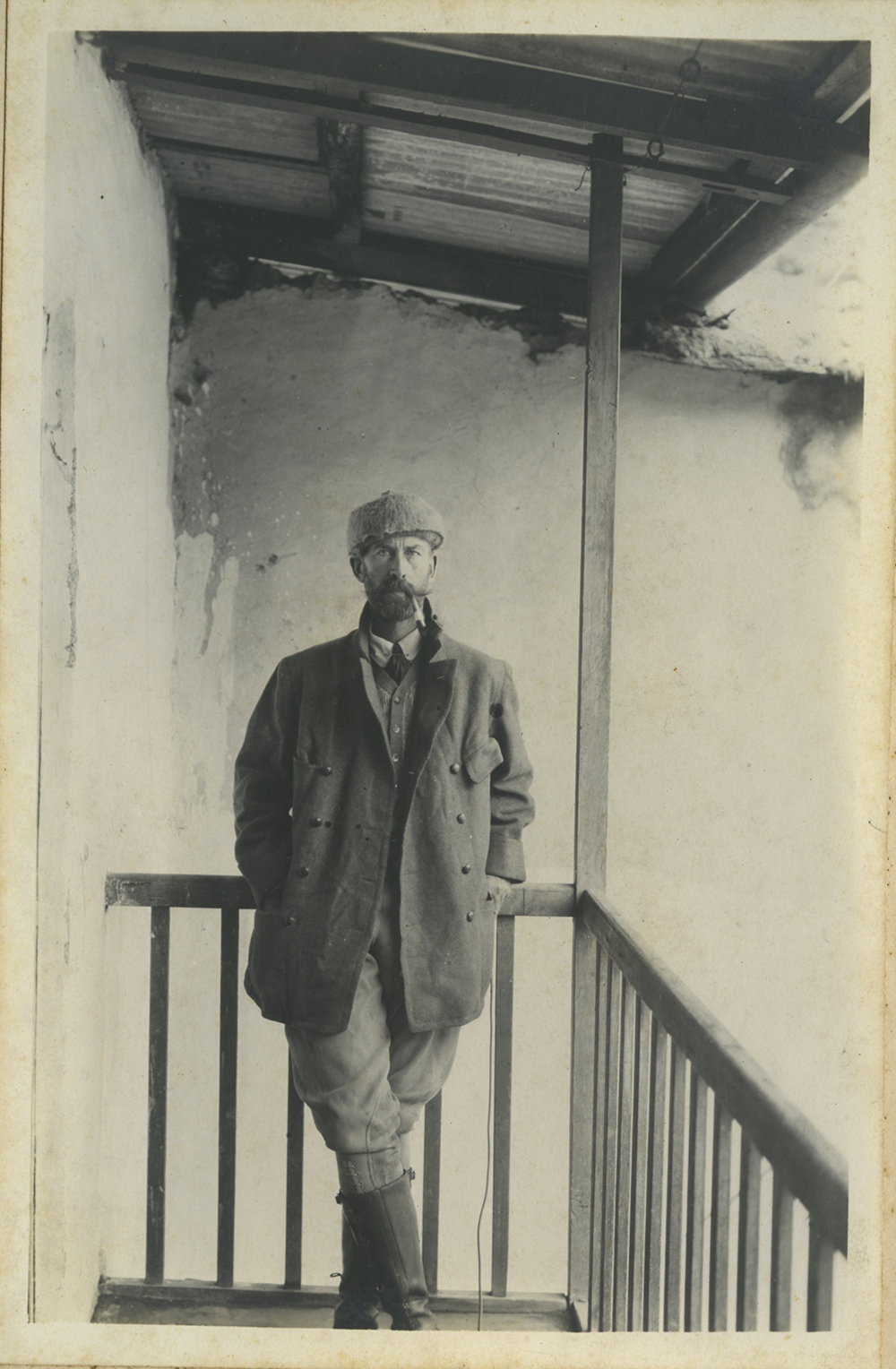
“The Lost City of Z – New Exhibition,” The Bill Douglas Cinema Museum, last modified May 14, 2018, accessed January 8, 2020.
After spending years in the Amazon, Fawcett was one of the world’s most prominent experts on the region. This, alongside his rough and adventurous demeanor, garnered Fawcett many supporters through the printing of his dispatches and reports in popular newspapers. Like athletes at the time, with the maturation of the newspaper, explorers were given a new level of name recognition. In 1925 Fawcett’s fame was at its peak as newspapers looked to cover his next expedition to find what could be one of the biggest discoveries of the century: an ancient city hidden deep in the Amazon jungle. Fawcett’s dispatches from this expedition were filled with detailed accounts of what he had encountered, and the public was voraciously reading each one until they suddenly stopped. Fawcett had predicted that he and his party might go silent for a few months at a time as they traversed difficult terrain under terrible conditions. However, as years began to slowly pass, people began to worry and speculate about what had happened to Fawcett. Several theories were churned out, yet as search parties looking for the truth came back with few answers, the mystery of Fawcett’s fate only became more alluring.
Why has an explorer who did not discover much that was historically significant been given so much attention both during his professional career and long after? Although Fawcett’s greatest accomplishments were mapping out portions of the Amazon rainforest, he has continued to be a figure of fascination today largely because of his disappearance. However, during his time he received just as much coverage by the media, albeit for different reasons.
(more…)
“The Bloody Crown” and “The Bloody Wall”: Two Macbeth Posters
By Katie Mao, IV Form
“The Bloody Crown” and “The Bloody Wall”: Two Macbeth Posters

The Bloody Crown
The first poster with the black background advertises a middle school play. I chose dark colors to emphasize that the play, Macbeth, is a tragedy. Not all middle schoolers know the plot at all, so I used color rather than words to show them what to expect. Middle schoolers might not take the time to read the rating or description of a play, so the bold colors might catch their attention. The colors strike a balance between being spooky and peculiar.
(more…)
The Essence of Luminescence: Light in The Great Gatsby
By Frances Hornbostel, V Form
The Essence of Luminescence: Light in The Great Gatsby
In The Great Gatsby, light is emblematic of the uncanny attraction to Jay Gatsby’s wealth and power, illuminating the warmth and clarity it brings as well as its isolation and superficiality. Light is ever-present throughout the novel, reflecting changes from dark, tempestuous times to brighter, more jubilant ones. These lighting shifts can be controlled by natural forces, immune to man’s intervention, or manipulated through artificial lighting, bought and directed by the buyer. Gatsby’s life, a whirlpool of bright lights ornamenting his extravagant wealth, is overwhelmingly attractive to those around him. He draws them in like moths to a flame as Nick notes early on, witnessing one of Gatsby’s ostentatious parties. Gatsby’s manipulation of light to highlight positive aspects of himself shows his attempts to control how people perceive him, further revealing the powers of isolation and superficiality light can have. Light is particularly revelatory in chapter five, where Gatsby’s manipulation is paramount in fabricating a perfect meeting with Daisy, the woman he has loved for the five years they have been apart.
After Gatsby invites Daisy over to his house, she excitedly brings him over to the window to show him that “the rain was still falling, but the darkness had parted in the west, and there was a pink and golden billow of foamy clouds above the sea” (Fitzgerald 94). Chapter five is set in isolation, away from mistresses, husbands, and reality, allowing Daisy and Gatsby to exist, for this chapter, at least, in a timeless state of idyllic bliss. However, the storm still raged, Tom was still a man bursting out in bouts of anger while was cheating with Myrtle, and their marriage still constricted Daisy at the ring finger. Daisy refuses to face these realities in chapter five as she lets herself float in the almost tangible softness of the pastel-painted clouds above the horizon, existing precariously between a storm and the raging force of the sea. Yet, rain is still falling around them, illustrating gravity’s heavy push on the dark elements outside of the floating oasis of billowing clouds that Daisy envisions, seemingly untouchable by gravity. The fragility of this state that is too perfect to be true alludes to its disintegration as reality hits after chapter five.
(more…)
Art Informed by Science: The Mediterranean Monk Seal
By Students in Studio I and Advanced Printmaking Students
Art Informed by Science: The Mediterranean Monk Seal
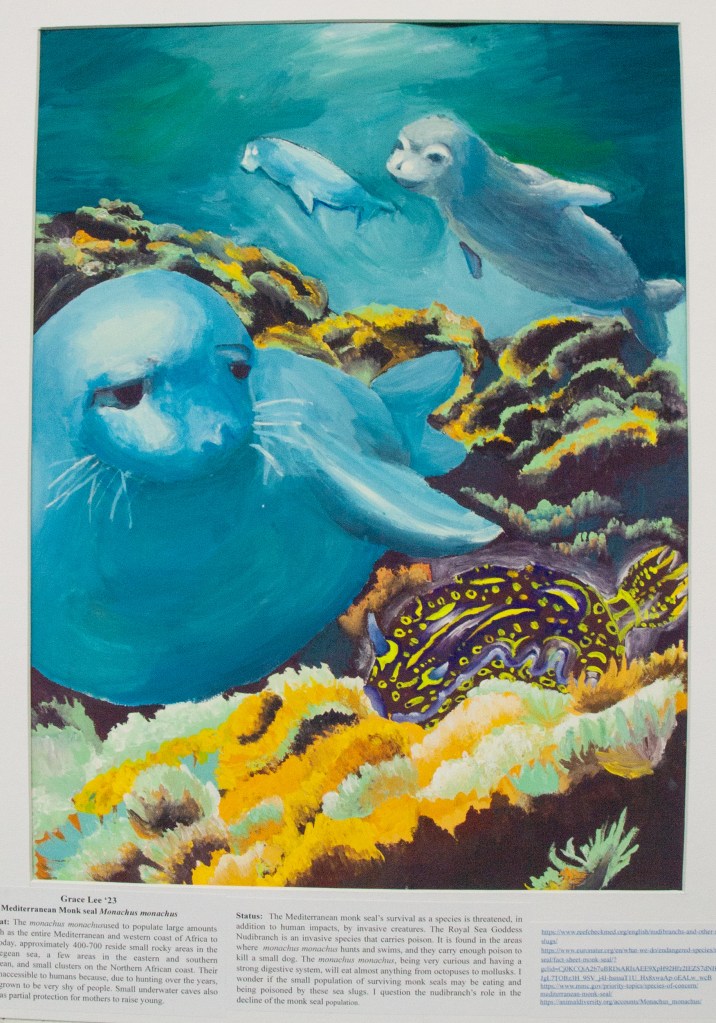
Instructor’s Note from Ms. Barbara Putnam: This is the first time I have done this assignment with the collaborative help of a scientist in the field. Dr Bundone is affiliated with University Ca’ Foscari of Venice and with Archipelagos, of which he is co founder, to save the critically endangered Monk Seal from extinction; There are thought to be only about 400. Currently, he and his team are working on a project to photo ID all of the remaining seals and catalogue them for protection and legislation.
Interspersed essay by Darius Wagner, III Form


The Effect of Visual Support on Learning: A Psychology Case Study
By William Osborne and Julian Yang, VI Form
The Effect of Visual Support on Learning: A Psychology Case Study
Abstract
Memorization plays a major role in education, especially throughout grade school and middle school. Despite this, many teachers support studying for memorization based tests by only repeating the information needed until it is stuck in the student’s brain. This study examines the positive effect visuals have on the brain’s ability to memorize words. Past experiments have found that the inclusion of images with text would increase a person’s ability to memorize and recall information. To test this, participants were given a short period of time to memorize ten words and then recall them. The same process was then repeated, but with a different list which also contained images of the words. The results showed that participants’ ability to memorize was facilitated with the use of images. One possible explanation is that the brain is able to mentally picture the image when remembering the words, giving it a concrete example to pull from instead of only a few letters on a page.
Keywords: Memorization, Visual Learning, Information Recall, Learning Strategy
(more…)
Colorblindness To Gender Inequality in the SM Community
By Ryley Holmes, V Form, and Hannah Macleod, IV Form
Colorblindness To Gender Inequality in the SM Community
Summary:
Despite gains made after the passing of Title IX in 1972, gender inequality still exists in school athletic programs. A close look at St. Mark’s athletics program helps suggest the ideas of gender equity in sports.
| Key Points:Due to Title IX, Women are unable to be excluded from participating in sports in educational institutions that are federally funded. However, we are socialized and have conformed to the norms that women do not participate in certain sports at St. Mark’s. Sports donors at St. Mark’s are required to donate to both the boys and girls varsity programs for a specific sport, as opposed to a particular gender in that sport to ensure equitable funding. However, those sports that only have one varsity team receive all of the funds for only one program. Men typically specialize in one sport whereas women tend to be members of multiple sports teams. This specialization is geared towards men, for their future income is reliant on playing a professional sport. This specialization is reinforced throughout all of American society. |


 LEO
LEO 