
Home » 2020 (Page 7)
Yearly Archives: 2020
Type 2 Diabetes as a Global Epidemic
By Charlie Rumrill, V Form
Type 2 Diabetes as a Global Epidemic
Type 2 Diabetes mellitus is a group of chronic disorders caused by either the number of pancreatic beta-cells, their ability to function, or the skeletal muscle and liver cells ability to transduce insulin’s signal, all of which result in hyperglycemia. Due to genetic, environmental, and epigenetic factors, Type 2 Diabetes has rapidly become a global epidemic.
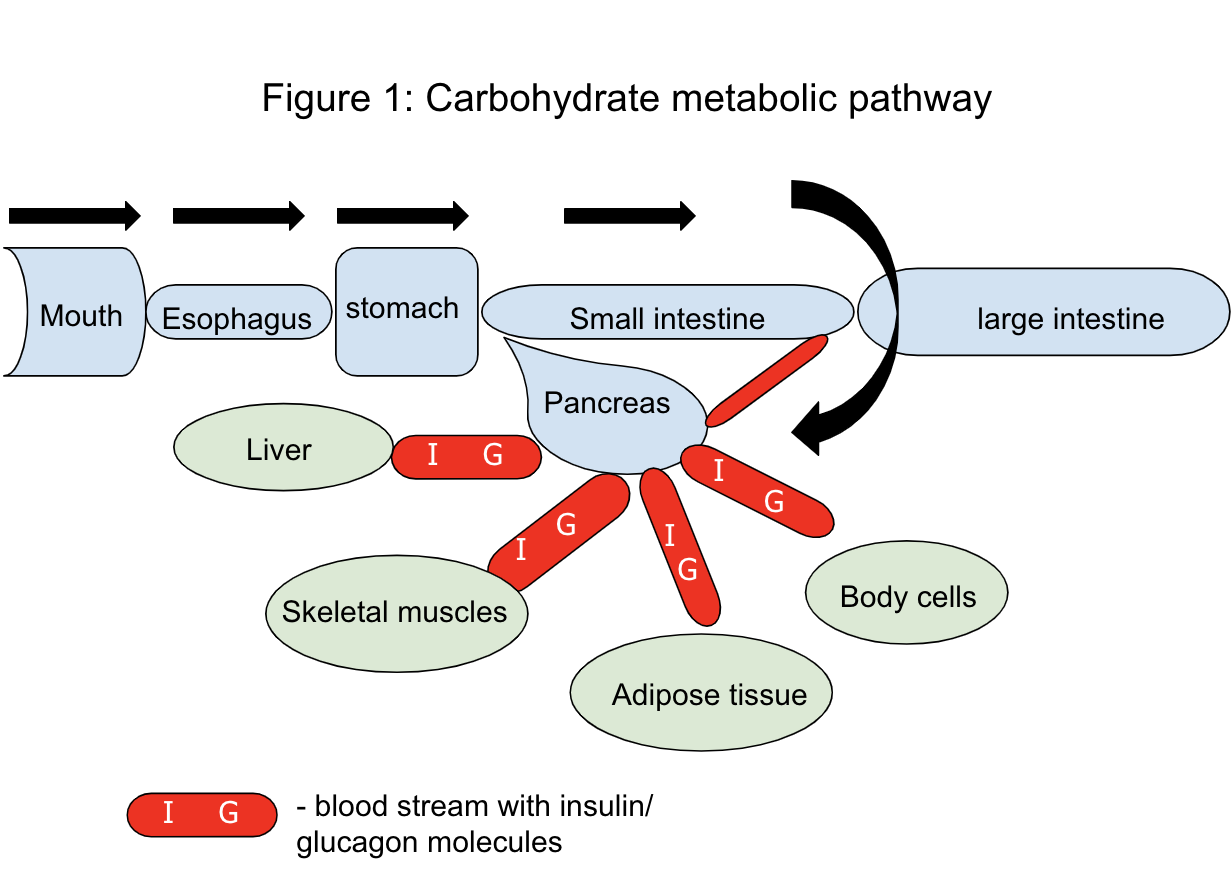
In order to understand the pathophysiology, or diseased state, of Type 2 Diabetes, a comprehension of how the body typically regulates carbohydrate metabolism is required. As shown in figure 1, the catabolism, or breakdown, of carbohydrates begins as soon as it is ingested, with salivary amylase enzymes hydrolyzing the large polysaccharides into smaller oligosaccharides. When the salivary mixture is swallowed, it continues through the esophagus to the stomach which denatures the enzymes with its highly acidic environment. Since no enzymes can function in the stomach, the digestion of the carbohydrates temporarily stops until it continues to the small intestine, where more amylase enzymes produced by the acinar cells in the pancreas meet the fluid in the small intestine and continue to hydrolyze the oligosaccharides into simpler disaccharides. As the mixture continues through the small intestine, brush border cells with enzymes attached hydrolyze the disaccharides into simpler monosaccharides, such as glucose. Only now can the once large polysaccharides be absorbed into the bloodstream. From the small intestine, the blood circulates directly to the pancreas, where the pancreatic beta-cells secrete insulin due to the elevated blood-glucose levels. Then, the blood flows to the liver and the rest of the body (Figure 1) where the liver and skeletal muscle cells bind to insulin, triggering more glucose transporters to be embedded in the cellular membrane. Due to the cells having more transporters, more glucose molecules can enter the cell, and the glycogen phosphorylase enzymes can bind them together through dehydration synthesis to form glycogen. Insulin also travels to the adipose tissue, where the glucose is then stored as fats. In addition to the effects of insulin, glucose molecules are constantly being taken into every cell in order for it to have the energy to complete its functions. Over time, due to the glycogen being produced and cells constantly needing glucose the body’s blood-glucose levels then lower. When the blood-glucose levels decrease, the pancreatic alpha-cells secrete the hormone glucagon which, when bound with the skeletal muscle and liver cells, triggers the glycogen to be hydrolyzed and released back into the bloodstream as glucose.

Ironic Joy in “The Lottery”
By Avery King, III Form
Ironic Joy in “The Lottery”
Shirley Jackson’s short story “The Lottery,” uses juxtaposition to show the town’s darkness through the beautiful summer day, the contrast of character’s names, and the difference in behavior between the adults and the children. “The Lottery” begins with a description of the beautiful summer day, which makes the reader assume that a joyful event will take place. The setting of summer implies a sense of hope and happiness because the day “[w]as clear and sunny with the fresh warmth of a full-summer day; the flowers were blossoming profusely and the grass was richly green” (Jackson 1). Often, the setting reflects the content of a story, but this is not true here. The characters’ names also show a contrast between darkness and light, for the name Mr. Summers is almost always closely followed by the name Mr. Graves to remind the reader that not everything is as light and good as it may seem. When Mr. Summers makes his first entrance with the black box, Mr. Graves comes in closely behind: “The postmaster, Mr. Graves, follow[s] him, carrying a three-legged stool, and the stool is placed in the center of the square, and Mr. Summers set[s] the black box down on it” (Jackson 1). Jackson deliberately chooses the last names of the characters to reflect the irony of the event. While the summer is supposed to be jovial, something grave and dark can ruin it. This “dark event” is precisely what happens to the town every summer when the Lottery occurs. Concurrently, before the town convenes for the Lottery, the children are happily running and playing because it is summertime and they are innocent. As the adults filter into the scene wearing somber expressions, the mood changes, and one begins to wonder why they are so sad while the children are happily collecting stones. In fact, “Bobby Martin ha[s] already stuffed his pockets full of stones, and the other boys soon [follow] his example, selecting the smoothest and roundest stones” (Jackson 1). While initially, the stone collection appears to be a fun game, the stones ultimately are used as weapons against Mrs. Hutchinson. Jackson contrasts innocence with harm and evil, even when initially it seems harmless. Jackson’s purpose is to show that everything has a balance in contrast. Through the description of the beautiful summer day, the contrast in the characters’ names, and the children’s game, Jackson shows that this Lottery is a corrupt event, for even the happiest of moments can contain darkness. Contrast allows Jackson to convey that the Lottery is not something to be celebrated.
(more…)
Service Learning Saturday Classes at the Chestnut Hill Farm
By Maya Scully, IV Form
Service Learning Saturday Classes at the Chestnut Hill Farm
For the future of this Saturday class, we hope to have more students sign up and continue to help Chestnut Hill Farm. This is such a great class that offers the opportunity to not only benefit ourselves, but also contribute something to our communities. This is a core value of the School and also a main part in contributing to a global society. We hope that students will step out of their comfort zones and try something new through this Saturday class. All of us have had such a great experience this fall because we got to spend time outdoors working and contributing to something collective and impactful. As the future generation of this world, students will important learn skills that are different from the ones learned in school. These skills carry into life long after high school and college. They teach us to have the right mindset and education, which will allow us to contribute to our society and make the world better. We assure you that you will not regret signing up for this Saturday class, so step out of your comfort zone and take this opportunity to better yourself and the community!


 LEO
LEO 