
Home » 2019 (Page 2)
Yearly Archives: 2019

A Statistical Analysis of Jury Sizes and Guilty Verdicts
By Kartik Donepudi, V Form
A Statistical Analysis of Jury Sizes and Guilty Verdicts
Given that a certain percentage, p, of jurors in a trial are inclined to vote guilty, which of the following is more likely?
- 6 jurors ruling guilty in a 6-person jury
- 10 or more jurors ruling guilty in a 12-person jury

Faith and Doubt: Emotion’s Place in Epistemology
By Daniela Ortiz, V Form
Faith and Doubt: Emotion’s Place in Epistemology
In this paper, I will argue that faith is comprised of knowing God without certainty. I will argue that this kind of faith does more good in the world than absolute certainty in God. People of faith must face doubt to strengthen belief. Although this seems paradoxical, the outcome of continuously facing doubt is a stronger commitment to looking beyond one’s self and following through on a commitment to treat all other people with respect.
Can we know God? Let us first define knowing.
Knowing is split into two categories- the logical knowing and emotional knowing. Logical knowing is what is certain and can be derived from the senses. In this, I agree with Hume. Knowledge of this kind is about the physical world around us and is known through data of the empirical kind such as our sensory information. There are limitations to what our senses can have us knowing. If a person’s senses deceived them, for example, by seeing a fake oasis in a desert, then this knowing may be faulty. But a singular type of incident should not be taken to alter the whole principle that logical knowing is defined by what we can perceive and what we can think. Also, logical knowing is similar to the way mathematics is used to model occurrences in the world. The use of logic conduces one answer. When there is only one answer, we shall call this certainty. When there are multiple answers, uncertainty begins. The category of emotional knowing often resides with uncertainty because our emotions are hard to maintain a grasp on long enough for one answer and train of thought to be maintained from the impression of the emotion. In section 2, paragraph 12, Hume makes a clear distinction between our thoughts and our impressions. Ideas are limited only to what we can expand upon from our sensory information, or from our desires and feelings. The argument here is sound. In paragraph 14, Hume explains that every thought we have is copied from a similar, earlier impression. Emotions may be short-lived, but they are more vivid, and all of our ideas about the world are formed from them (Hume 2). To bring it to a point: although emotions are fleeting, the emotional knowing should not be discounted as our impressions are stronger and more vivid than the ideas they will eventually inform.
(more…)
The Evolution of Lactose Tolerance
By Thomas Yuang Li, IV Form
The Evolution of Lactose Tolerance
Some people are lactose tolerant because they are lactase persistent (LP). Lactase is an enzyme responsible for the hydrolysis reaction or breakdown of lactose, the sugar in milk, and it helps human digest milk. LP is the continued activity of lactase in human adulthood. LP occurs because of the inheritance of genetic mutations that result in LP. It became prevalent in some societies due to evolution through natural selection. As of 2018, around 65% of the world population experienced lactose intolerance (NIH). The distribution gradient is uneven, for about 90% of the population in East Asia are lactose intolerant while about only 10% of the population in North Western Europe are lactose intolerant.
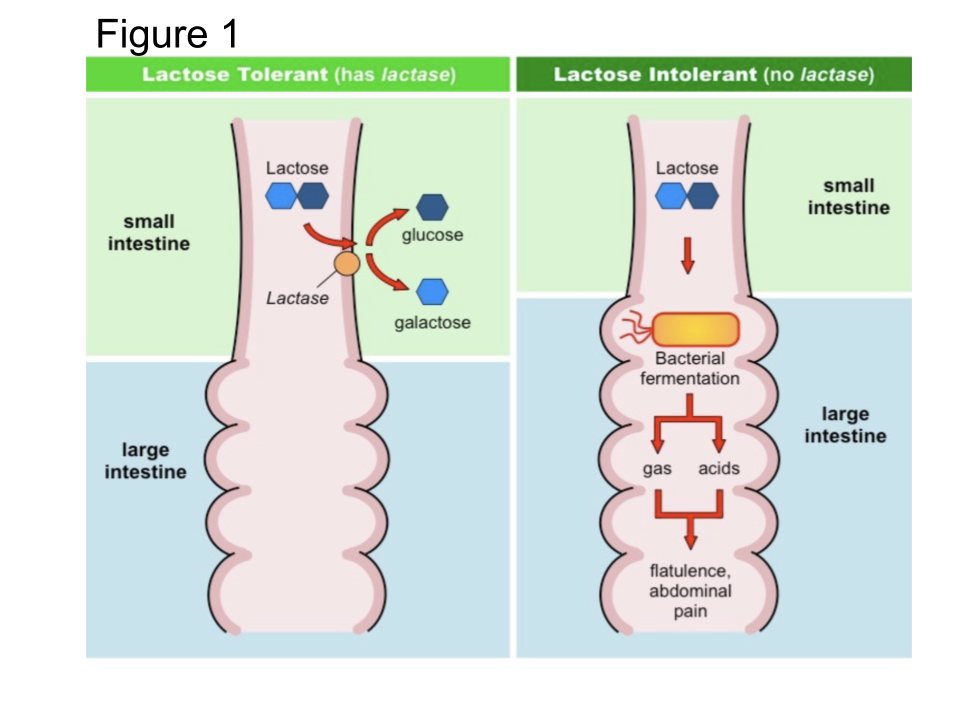
Lactose is a disaccharide that contains a galactose and a glucose unit. Lactose makes up 6-8% of milk. Humans can only digest lactose with the help of lactase, making lactase critical in the digestion of milk. Lactase is produced by small intestine cells. It accelerates the hydrolysis reaction or breakdown of lactose. Through hydrolysis, lactose is broken down into glucose and galactose, which are monosaccharides, or simple sugar molecules, that can be absorbed into the human bloodstream. Lactase catalyzes this hydrolysis reaction by lowering the activation energy, the minimum energy required to initiate a chemical reaction. Without sufficient lactase, humans cannot fully digest lactose. As shown in Figure 1, the undigested lactose then passes on to the large intestine, where it interacts with bacteria and ferments. The fermentation causes symptoms of lactose intolerance, which range from bloating to diarrhea.

The One-Minute Photo Challenge: A St. Mark’s Saturdays Final Product
By Holden LeBlanc, Mateo Macri, and Hudson Ramirez, V Form
The One-Minute Photo Challenge: A St. Mark’s Saturdays Final Product
In the off-camera flash photography course, students learned the technical knowledge needed to use flash “off the camera,” where the camera triggers the flash remotely with the use of wireless triggers. OCF gives photography depth and texture; it enhances the creative process and allows one to create moods and incredible effects.
Instructor Note from Mr. Bauer: On the last day of class, students were tasked with demonstrating their best work to showcase the tools and skills they had learned throughout the fall. Holden LeBlanc, Mateo Macri, and Hudson Ramirez decided to embark on “The One-Minute Challenge.” They walked around the school on Saturday morning asking subjects to give them a minute to take their picture. They filmed the process and edited the video.

Globalization Through Glow Sticks
By Andria Bao, III Form
Globalization Through Glow Sticks
Editor’s Note: For this assignment, III form students in The Global Seminar (TGS) were asked to create an infographic that could tell the story of globalization through a chosen product.


Johns Hopkins Medicine and Healthcare Summit: A Kean Fellowship Grant
By Cara Mulcahey, V Form
Johns Hopkins Medicine and Healthcare Summit: A Kean Fellowship Grant
Editor’s Note: This opportunity and article were made possible by the Kean Fellowship Grant. Kean Fellowships will be conferred upon a small number of highly well-qualified students who propose and undertake independent research and study in the field of public service, exploring meaningful domestic public policy issues. Once selected, and on the basis of their topic, Fellows will work with a faculty mentor and find meaningful connections with academicians and leaders in the field of public policy. The Fellowship will engage the students in cutting edge topics and in a manner that is serious and capitalizes upon what they have learned at St Mark’s. Project proposals for the Kean Fellowship might take the form of a capstone project, a senior project, independent study and/or may include summer work .
Over the summer, I spent a week and a half at a medicine and healthcare summit at Johns Hopkins University in Baltimore, Maryland. The summit, run by the program Ambassador Leaders, was meant to help prepare me for my journey to become a doctor. The leaders of the summit brought in undergraduate students majoring in STEM fields, current medical school students, and numerous doctors for Q&A sessions. These sessions enhanced our understanding of the admission processes and prepared us for each step of becoming part of the medical field. Session facilitators also brought in doctors and nurses to teach us different medical procedures and tasks such as suturing, CPR/AED, checking vitals and reflexes, and stopping choking. Additionally, we traveled to the University of Maryland’s Shock Trauma Center to become certified in stopping life-threatening bleeding, a skill that can prevent countless deaths.
(more…)
Gender Inequality and Unreliable Narration: Two Paragraphs on The Great Gatsby
By Felicity Keyzer-Pollard and Lina Zhang, V Form
Gender Inequality and Unreliable Narration: Two Paragraphs on The Great Gatsby
The Inherent Unreliability of Nick Carraway
By Felicity Keyzer-Pollard
Whether intentional or not, Nick Carraway’s first-person narration of The Great Gatsby dictates every aspect of the novel leading to an innate unreliability. Initially, Fitzgerald attempts to present Nick to the reader as a reliable narrator by highlighting his belief in “reserving judgments,” and letting the reader feel as if Nick is a voice of reason in a convoluted society (2). Nevertheless, it is vital to recognize that even reliable narrators can distort the very core of a novel. This distortion becomes apparent as Nick presents Jay Gatsby, the novel’s eponymous character. Initially, he describes Gatsby as nearly god-like by chronicling his persona by the “whispers about him from those who had found little that it was necessary to whisper about in this world” (Fitzgerald 44). This verbiage around Gatsby sets up the larger-than-life persona of him that the majority of characters believe to be true. However, this narration is not entirely authentic. Nick narrates The Great Gatsby from a future perspective, meaning he already knew the truth about Gatsby. While Nick attempts to remain impartial when explaining how James Gatz became the infamous Jay Gatsby, he already acknowledges that “Jay Gatsby of West Egg, Long Island, sprang from his Platonic conception of himself” (Fitzgerald 98). His decision to withhold this information, whether intentional or not, misleads the reader. This choice means that when Nick tells Gatsby he “can’t repeat the past,” he is highlighting one of the critical flaws in his own narration (Fitzgerald 110). Nick is telling this story in an attempt to recount the past. However, in Nick’s own words, he is unable to accomplish this. The narration style that Fitzgerald chodse cast Nick into the role of an unreliable narrator regardless of intention. Consequently, the inherent unreliability of Nick Carraway’s narration fundamentally shapes the reader’s understanding of The Great Gatsby.
(more…)
What is Folk Music?
By Mr. Richard “Nick” Noble, ’76, Communications Department
What is Folk Music?
Editor’s Note: This article was previously published at WICN.org.
Essays with questions for titles can be annoying. They are often an excuse for the author to preach his or her opinion with passionate, proselytizing vehemence as if picking a fight with potential readers genuinely curious about the answer. I hope this won’t be one of those, but quite honestly I can make no guarantees. If I had a dollar for every time I have been asked this question in the twelve-plus years I have been hosting THE FOLK REVIVAL, I would have retired a rich man long ago. For a long time, I stopped trying to answer the question “What is Folk Music?” because when I did, it invariably started an argument. People, it seemed, almost always asked the question having their answer already in mind. And their answers—strongly held opinions and beliefs—were often quite disparate.
Go ahead: Google it. Even everyone’s go-to, Wikipedia, can’t make up its mind. The very first line of its “Folk Music” entry has to equivocate:
This article is about traditional, non-commercial folk music. For the 20th-century style associated with a wide variety of subgenres, see Contemporary folk music. “Folk Songs” and “Folksinger” redirect here. For other uses, see Folk Songs (disambiguation) and Folksinger (disambiguation). (Wikipedia)
(more…)

 LEO
LEO 